
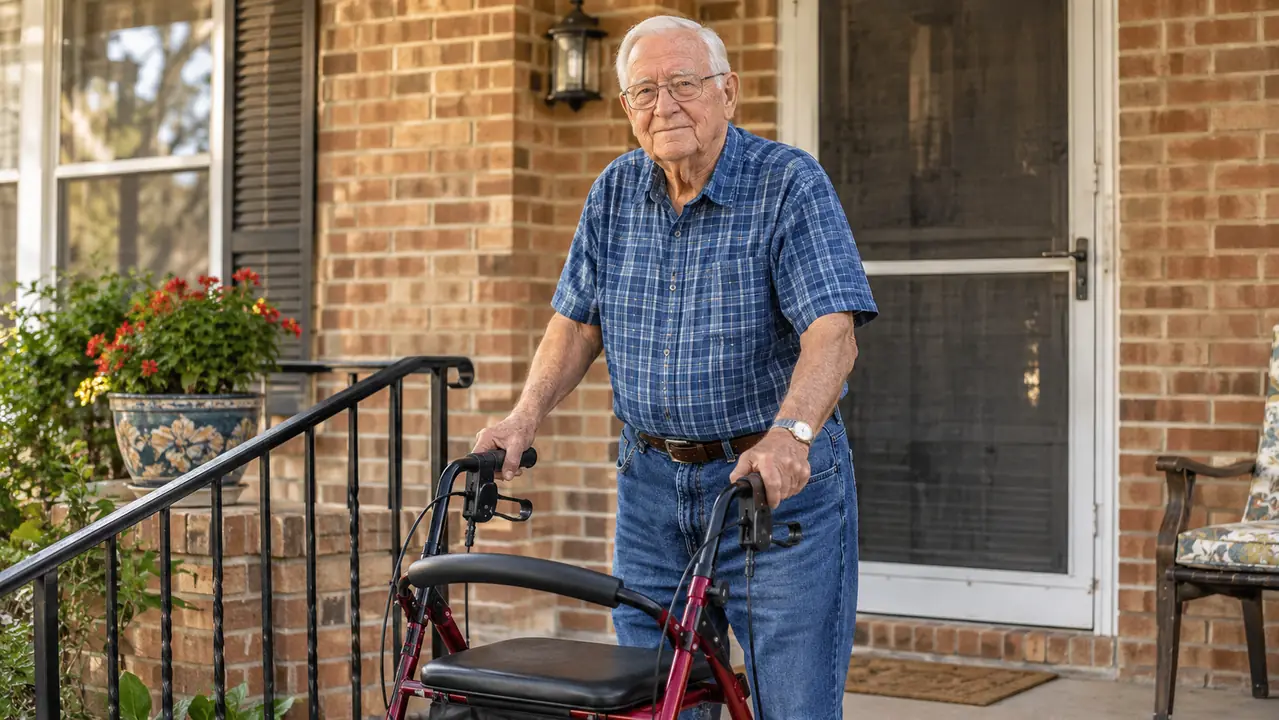
The first week I had the Drive Medical rollator with seat, I left it in the carport for three days and kept using the loaner two-wheel walker from the hospital equipment closet. I am Hal Brockman, 74, retired after 31 years on a rural mail route out of Tupelo, Mississippi. I had my right hip replaced in the spring about 18 months ago. The loaner got me from the bed to the bathroom for the first six weeks. Then my physical therapist told me to move to something with wheels and a seat. I did not want to. A rollator looked like a surrender flag with wheels. Doris, my wife, said it looked like a place to sit down. She was right, and I hate that.
I figured I could get by with the loaner and a hand on Doris's arm. That worked until the Wednesday morning coffee at the feed store, when my old route buddies got to talking and I stood too long. By the time we lined up at the counter, my hip had that hot, tired feeling and I was leaning on a display of birdseed. Nothing dramatic happened. I did not fall. But I knew I was one wobble away from a bad morning. The Drive Medical rollator came home the next week. I have used it for about 16 months now, mostly for outings: the feed store, the grocery with Doris, and the walk down the gravel lane to the mailbox. This is what it has done and what it has not.
The Quick Verdict
The seat is the reason this rollator earns its space in the carport. It is stable, it folds into the truck bed, and the 7.5 inch wheels handle my packed gravel lane. At 20 pounds it is not light, and it is no good on the three steps to my kitchen door. For outings, it changed my week.
Amazon Check Today's Price →The seat that lets a Wednesday morning run long
I am not going to pretend this rollator made me 25 again. It gave me a place to rest when my hip quit, and that changed how long I stayed out. The listing shows a 350 pound capacity and a limited lifetime warranty. Check the current price and the fit for your own body.
Amazon Check Today's Price on Amazon →How I've Used It
My physical therapist moved me off the loaner two-wheel walker and onto the Drive Medical rollator about 16 months ago. The loaner went back to the hospital equipment closet. The rollator lives in the carport beside the door, not in the house. I use it for the outings where I know I will be on my feet longer than 20 minutes: Wednesday coffee with the old route buddies at the feed store, the grocery store with Doris, and the walk down the gravel lane to the mailbox. It does not go to church. It does not go up the three steps from the carport to the kitchen. Those steps have a handrail, and I take them one at a time with nothing in my hands.
At the feed store, I park it near the coffee table and sit on the seat when my hip tells me to. At the grocery, Doris takes the list and I follow with the rollator. When the line is long, I sit. When I am done, I stand up, put both hands on it, and go again. That sounds small if you have not been the man calculating every step. It is not small. The first month, I used the seat twice a visit. Now I use it once, sometimes not at all. That is not a cure. It is just less fear about being far from the truck.
At home, it stays by the carport door. I do not use it to get from the recliner to the kitchen. For that, I use the walls and the counter like every other stubborn man in Tupelo. The rollator is for distance and for standing in lines. It is for the days when I want to be out in the world and not thinking about where the next chair is. The first weeks, I noticed the difference in my shoulders more than my hip. I was not leaning on Doris's arm or holding on to shelves. I was walking at my own speed. That is worth more than it sounds.

What the Seat Changed on Wednesday Mornings
Wednesday coffee is the fixed point in my week. My old route buddies meet at the feed store, and we solve the county's problems for an hour. Before the rollator, I would stand for a while, then find a stool or a stack of feed sacks. I would leave early. After the rollator, I sit on the seat when I need to and stay for the second cup. The seat is not a recliner. It is a firm place to park for a few minutes. That is all I need.
The first Wednesday I brought it, one of the fellows asked if I was moving in. I told him I was. The seat is the whole argument. A rollator without a seat is just a walker with wheels. The seat is what lets me say yes to the grocery store on a hot morning, or to the long walk down the gravel lane when the mailbox is full of catalogs. I sit, I catch my breath, I get up. Nobody has to find me a chair. That is the difference between an outing and an ordeal.
Doris noticed it before I did. She said I was not watching the clock. Before, I would ask how much longer in the hardware aisle. Now I follow her and sit when I need to. The rollator does not make me faster. It makes me less worried about the distance back to the truck. That is a quiet kind of improvement, and it took a few weeks to trust it. I still carry my phone. I still tell her where I am going. But I am not calculating every step.
The Truck Bed Test
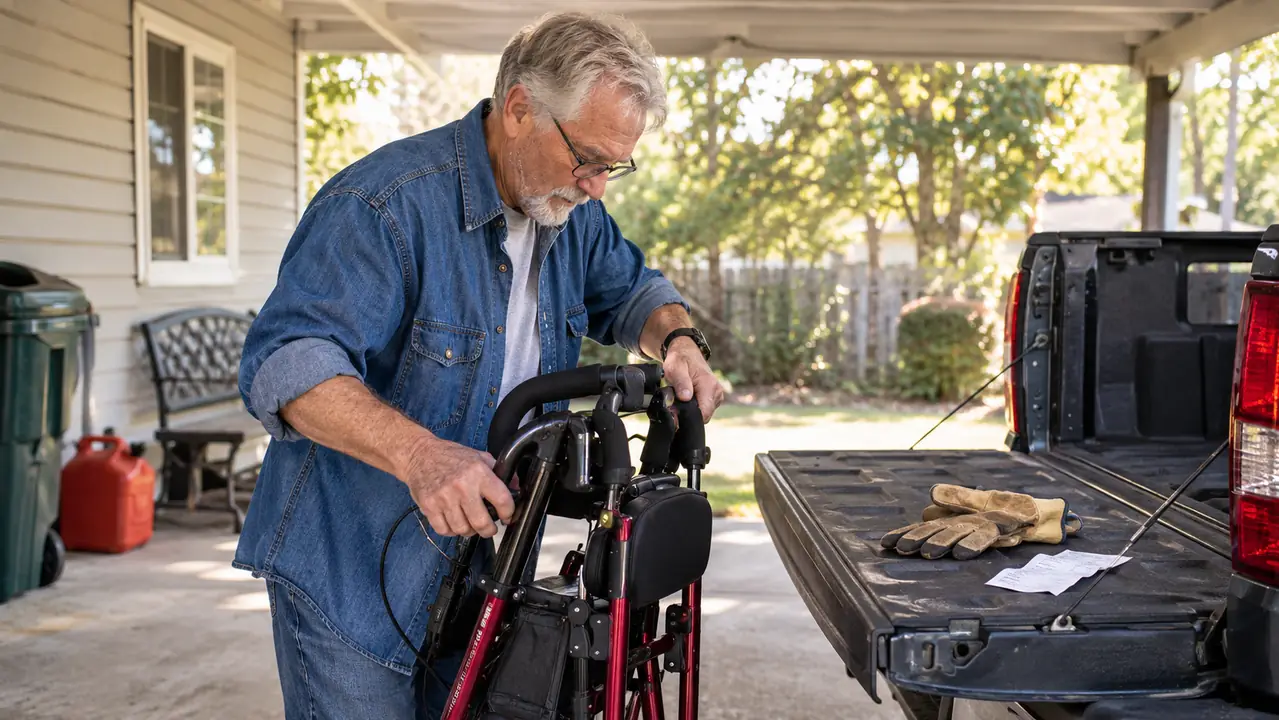
The rollator has to travel in a full-size pickup, and that is where the folding matters. The back support folds down and lifts off, and the frame closes up. I can lift it into the truck bed on a good morning. At 20 pounds, it is not a feather. On a bad morning, Doris or Wade lifts it. Wade is my son, and he lives about 30 minutes away in Saltillo. He set up the height when I first got it and showed me how the back support comes off. I have not needed him to do it since, but I know he will.
The 7.5 inch wheels are the reason it works on my lane. The lane is packed gravel with a few soft spots near the culvert. The rollator rolls over the packed part without fighting me. On the loose gravel, I go slower and keep both hands on it. I have not tipped it. I have not fallen. I am careful, and the bigger wheels help. If I had to go through deep sand or up a curb every day, I would want to talk to my physical therapist about a different setup. For my lane and the feed store parking lot, it is enough.
Folding it is simple enough that I do it without thinking. The back support comes off, the frame closes, and it slides behind the front seat or into the truck bed. It does not fold into a package the size of a briefcase. It is still a rollator. But it takes up less room than the loaner did, and I can manage it without a tool. The height adjustment lever is the one thing I set once and leave alone. My physical therapist found the height for me. I marked it with a piece of tape so I would not fuss with it.
Where the Drive Medical Rollator Stumbles
It is 20 pounds. That is the number I come back to. On a good day, I lift it into the truck without a thought. On a tired day, or a morning when my hands are stiff, it is a chore. If you have shoulder problems or a bad back and no one to help, this is not a light piece of equipment. The listing says 20 pounds, and I believe it. The limited lifetime warranty is good to have, but it does not lift anything. You need to be honest with yourself about the truck and the steps before you buy.
The frame is 21.5 inches wide. In a narrow aisle, it takes up room. I have learned to go down the middle and let people pass. The seat is not a place to sit through a whole meal. It is a place to rest for a few minutes. The three steps from my carport to the kitchen are not rollator country. No rollator is. I leave it at the bottom and use the handrail. If your house has a full flight of stairs between you and the bathroom, this is not the tool for that. It is for the flat ground and the outings.
It also does not go to church with me. The pew rows are tight, and the rollator would be in the way. I use a cane there. That is not a knock on the rollator. It is a different job. The rollator is for the feed store, the grocery, and the lane. The cane is for Sunday and short trips. If you need one aid to do everything, you will be disappointed. If you need one aid to get you back to the outings you miss, this one has earned its keep.
What I Liked
- Seat gives a real rest on outings, not a token perch
- Folds and fits in a pickup truck bed or behind the front seat
- 7.5 inch wheels roll over packed gravel and store floors
- Height adjustment and a 350 pound listing capacity
Where It Falls Short
- 20 pounds is a real lift on a tired morning
- 21.5 inch width is tight in narrow aisles
- Not for steps, pew rows, or a full flight of stairs
- Seat is for short rests, not long sitting
The seat is what lets me say yes to the grocery store on a hot morning. It is not a cure. It is a place to rest, and that is enough to change the shape of a week.
Who This Is For
This is for the man or woman who can walk but does not trust the distance. If your hip or knee decides when the errand ends, and you have been avoiding the feed store or the grocery because you are not sure where you will sit, this is the kind of tool that helps. It is also for the person who has a truck or SUV and someone to help with the lift on a bad day. The 350 pound listing capacity covers a lot of bodies. The height adjustment covers a range of heights. My physical therapist set mine, and I would tell you to do the same.
It is for the person who wants to stay in the world, not just get from the bed to the bathroom. That was the shift for me. The loaner walker was for recovery. The Drive Medical rollator is for living. Wednesday coffee, the grocery with Doris, the walk to the mailbox. If that sounds like your week, it is worth a look. Ask your doctor or physical therapist about fit and use before you buy. A rollator is not a prescription, and it is not a cure. It is a tool.
Who Should Skip It
Skip it if you cannot lift 20 pounds and you do not have someone nearby to help. Skip it if your main problem is stairs. Skip it if you need something for church pews and tight restaurant rows. The rollator is wide and it is not a folding cane. I use a cane on Sunday for that reason. If you are mostly indoors on flat floors and you do not need a seat, a lighter walker or a cane may be less trouble. I am not going to sell you a truck bed full of iron if a cane will do the job.
Skip it if you want a chair. The seat is for a few minutes of rest, not an afternoon of sitting. Skip it if you are not willing to adjust the height and learn where the balance point is. The first week, I was too proud to use the seat. That was a waste of a good tool. If you will not sit down in public, this rollator will not do much for you. The seat is the point. Use it.
If your hip decides when the errand ends, start with the seat
The Drive Medical rollator is not a cure and it is not light. It is a stable place to rest on the outings you have been skipping. Check the current listing, the 350 pound capacity, and the height range. Then ask your physical therapist to set it up for your body.
Amazon See the Current Price on Amazon →