

For the first six weeks after my hip replacement I got around on a standard two-wheel walker. Two small wheels in front, two rubber-tipped legs behind, a folding frame, and nothing else to it. It was a loaner from the hospital equipment closet, and I was glad to have it at two in the morning when the bathroom seemed a long way off. Then Doris took me to the grocery store with it and I understood the difference between a walker that keeps you upright and a walker that lets you go somewhere.
Here is the short answer before the long one. If you want to leave the house, sit down when you need to, and cover ground at the feed store or the grocery without hunting for a bench, the Drive Medical rollator with the seat is the better tool. It is the one still sitting by my kitchen door sixteen months later. If your whole job is steadying yourself between the bed and the bathroom, a plain two-wheel walker is lighter, narrower, and easier to live with in a tight hallway. Most of us end up wanting both, in that order, and there is no shame in it.
| Drive Medical Rollator | Standard Two-Wheel Walker | |
|---|---|---|
| Seat and resting | Padded seat with a fold-up, removable back support, so a break is a place to sit | No seat. A break means finding a bench or leaning on a shopping cart |
| Brakes | Hand brakes on the handles, so it holds still while you get yourself arranged | No brakes. You set it down and trust the floor |
| Ground clearance | 7.5 inch wheels roll over gravel, door sills and cracked concrete | Small front wheels and two bare tips, which catch on ruts and sills |
| Weight | About 20 pounds by the listing, and I feel it when I am tired | Lighter, and easier to swing into a truck bed |
| Tight spaces | 25.5 inches deep by 21.5 wide by 34 tall, which is furniture in a hallway | Narrow and fold-flat, easy to keep against a wall in a small bathroom |
| Gait and effort | Push and walk, which suits a longer outing | Lift and place, which slows you down on purpose in the first weeks |
| Warranty | Limited lifetime warranty on the frame | Varies by maker, and a loaner comes with no warranty at all |
| Best for | Outings, gravel lanes, lines, and anywhere you might need to sit | The bed, the bathroom and the kitchen in the first weeks after surgery |
That table is how I would sort them if a neighbor stopped me on the porch and asked straight out. I have marked each row for the one that actually does the job better, and I have given the two-wheeler its due where it earned it.
How I Came to Use Both
My physical therapist is the one who moved me off the loaner. She stood at the end of the hall and watched me come toward her, lift, place, lift, place, and then she asked how far I could go before my arms gave out. The answer was not far. A two-wheel walker makes you pick the whole frame up and set it down with every step, and six weeks out from a hip replacement that is a great deal of picking up. She had me try a four-wheel rollator in the clinic that same afternoon. You push instead of lift, and my stride came back to something that resembled a stride.
I bought the Drive Medical rollator about sixteen months ago. Steel frame, 7.5 inch wheels, hand brakes on the handles, a padded seat, and a back support that folds up and comes off entirely if you would rather it did. It lives in the carport beside the kitchen door, and it goes to Wednesday morning coffee at the feed store, to the grocery with Doris, and down the gravel lane to the mailbox on decent days. I have never carried it into church. That is the cane's job, and the cane stands up by itself beside the pew.
The loaner walker went back to the hospital closet after six weeks and I have not missed it. I will not pretend it was useless, though. There were nights in that first month when the narrow thing that folds flat against the bedroom wall was exactly right, and a twenty pound cart with a seat on it would have been in my way between the bed and the door. Tools have jobs. That is all I am saying.

Where the Drive Medical Rollator Wins
The seat is the entire argument, and I did not see that coming. At the feed store the coffee table is a folding table in the back with six chairs around it, and there is always one man in the group who needs to sit before the others do. For a while that man was me leaving early. Now I park the rollator, set the hand brakes, sit down on the padded seat with the back support up behind me, and I am still there for the second pot. That sounds like a small thing to anyone who has not lost an afternoon to it. It is not small. It is the difference between going and not going.
The wheels are the second argument. Seven and a half inches of wheel does not sound like much until you have pushed a two-wheel walker down a gravel lane to a mailbox. A two-wheeler has small front wheels and two bare tips behind, and every rut, root and door sill is a chance to catch and tip. The rollator rolls. It goes over the sill at the kitchen door, over the cracked concrete in the church parking lot, over the gravel, and I am not staring at my own feet the whole way. It also holds still when I want it to. The hand brakes let me lock it in place before I sit, and I have come to trust that more than I expected.
Where the Standard Two-Wheel Walker Wins
Now the other side of it, and I mean this. A two-wheel walker is lighter and narrower, and in a small house that is not a small advantage. My bathroom is not generous. The loaner sat beside the shower stall and against the wall without me moving a single thing. The rollator takes up room. The listing gives it as 25.5 inches deep, 21.5 inches wide and 34 inches tall, and in a hallway that is honest furniture. If you are steering it in the dark between the bed and the bathroom at two in the morning, the plain fold-flat walker is the easier thing to own.
The other thing a two-wheeler does better is slow you down. That reads like a complaint and it is not one. When you have to lift and place the frame with each step you cannot hurry, and in the first weeks after surgery hurrying is the enemy. My physical therapist used it that way on purpose. More weight through the legs, more deliberate steps, less drifting to one side. She also pointed out that there is nothing on it to sit on, so you do not stop and rest in the middle of the hall. You keep walking the ten feet to the bathroom and you are done. The rollator makes a break easy. Sometimes easy is not what the therapist wants.
The one still sitting by my kitchen door after sixteen months
Steel frame, 7.5 inch wheels, hand brakes, padded seat, fold-up removable back support. Sixteen months of gravel lanes, grocery aisles and Wednesday coffee. Check today's price and the current listing details on Amazon.
Amazon Check Today's Price on Amazon →What the Listing Numbers Mean in a Carport
The listing says 20 pounds, and that number is accurate enough that I notice it. I lift it into the truck bed myself on a good morning and I ask Doris or Wade to do it on a bad one. Twenty pounds is not heavy. It is also not nothing when the truck sits high and your hands are stiff in the morning.
It says a 350 pound capacity and a limited lifetime warranty. I cannot test the capacity and I would not try. What I can tell you is that the frame is steel and it feels like steel. After sixteen months in a Mississippi carport, hot and damp by turns, nothing on it has worked loose or started to wobble under me. The seat pad has taken the shape of the people who sit on it. That is the only wear I can point to.
The back support comes off, and I have used it that way exactly twice, both times when I wanted to sit sideways and look at the garden. Mostly it stays on and folded up. The padded seat is the part that matters, and the pad is a firm one. You can sit on it fifteen minutes at the feed store without your hips telling you about it. Two hours, no.
The height range matters more than any of the other numbers. The listing gives a maximum height of 35 inches and a minimum height recommendation of 59 inches for the person using it, and there is a height adjustment lever on the handle. Set the handles so they land near the crease of your wrist when your arms hang, and have your physical therapist check the setting rather than trusting your own eye. I ran mine too low for a month and could not work out why my shoulders ached every Wednesday. Wade raised it an inch and the ache was gone.
I park it, set the brakes, sit down, and I am still there for the second pot. That is the difference between going and not going.
The Wednesday Coffee Test
Here is the test I would hand any mobility aid before I trusted it with my mornings. Can you take it to the feed store on Wednesday, park it, sit down, get back up, and load it into the truck afterward without asking a soul for help? The rollator passes that test. The loaner walker did not, not because it was badly made but because there was nowhere to sit and nothing to lean on while I got my feet back under me in a gravel lot.
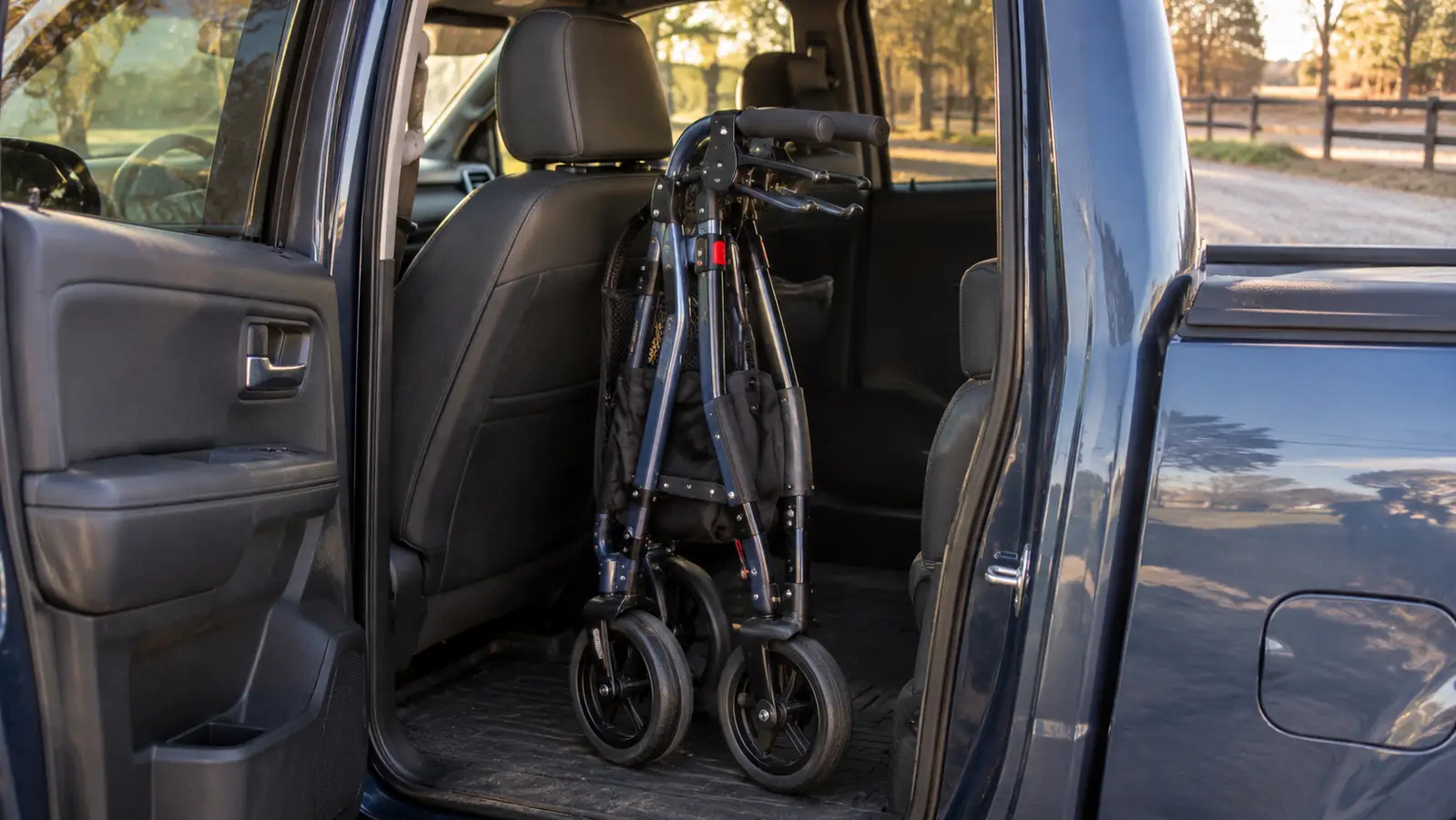
The second half of the test is the truck. Anything that travels with me goes behind the front seat or in the bed of a full-size pickup, so folded size and weight are not trivia. The rollator folds down and goes in the bed, and I pull it out by the frame. The loaner folded flatter and slid behind the seat without any drama, and on a wet morning I missed that about it.
Doris is the one who notices things before I do. She noticed when I stopped going to the back of the grocery store, and she noticed when I started waiting in the truck instead of coming inside. That is what the unsteady part does to a man. It shrinks the map. Sixteen months with the rollator has not put the map back where it was, but it has put the back aisle of the grocery and the far end of the feed store back on it. She pointed that out in the truck one Wednesday, and she was right.
What Still Bothers Me About It
Nothing on it is a cure for anything, and I want to be plain about that. A rollator is a chair with wheels on it. It steadies you. It does not fix your balance, it does not make your hip stronger, and it does not decide for you whether you should be walking that far in the first place. Since my hip replacement I have been unsteady when I am tired, in the dark, and on uneven ground, and the rollator helps with two of those three. In the dark it is a piece of furniture I have to steer around.
The other thing I would change is the size in the house. It is a cart, and carts have to go somewhere. In the carport it is fine. In the kitchen it is in the way of the dishwasher door. I ended up parking it on the carport slab outside the kitchen door and walking in under my own steam, which is the correct arrangement for me and not one the listing tells you. You will find yours. Give it a week.
Who Should Buy Which
Buy the Drive Medical rollator if you leave the house. If your outings involve standing in a line, walking more than a hundred feet, or ground that is gravel, cracked concrete or grass, the 7.5 inch wheels and the seat are the reasons I can make that trip alone. Buy it if you have ever cut a visit short because you could not see a place to sit down. Buy it if your balance is worse when you are tired, because that is the whole reason a seat on wheels earns its keep.
Stay with a standard two-wheel walker, or borrow one first, if you are in the first weeks after surgery and your therapist wants a slow and deliberate gait, if your house is tight and your trips are the bed, the bathroom and the kitchen, or if you need something that folds flat against a wall and weighs nearly nothing to lift. And be honest with yourself about the 20 pounds, because the rollator only helps you if it comes along. Either way, ask your doctor or your physical therapist to look at the fit and the handle height before you lean on the thing. Their word outranks mine.
Sixteen months in the carport and it still earns its spot
The Drive Medical rollator with the seat: steel frame, 7.5 inch wheels, hand brakes, padded seat, fold-up removable back support, 350 pound listing capacity and a limited lifetime warranty. Have your physical therapist check the height first, then look at today's price.
Amazon See Today's Price on Amazon →