
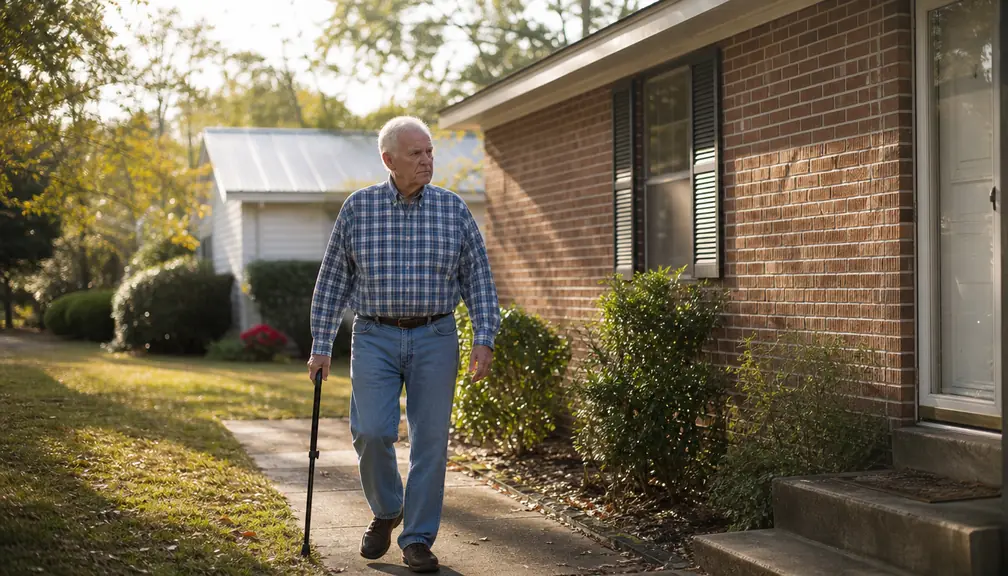
The walk from my carport to the kitchen door is three steps and about twelve feet of concrete. I have made that walk more times than I can count. About two years ago I started thinking about it, and that is how I knew something had changed.
Steadiness does not leave all at once. It goes a little at a time, and the way it announces itself is that you start planning. You plan which hand carries the coffee. You plan the route through the living room so there is something to touch every few feet. You make two trips where one used to do. I did all of that for months before I said a word to my wife or my doctor. What helped in the end was not a big thing. It was a folding cane from HONEYBULL, bought about a year ago, and five habits I built around it. I am 74. I had a right hip replaced about 18 months ago, and I am unsteady when I am tired or in the dark.
Five habits, one cane, and the walk stops being a decision you make
The HONEYBULL folding cane adjusts from 30 to 36 inches with a push button, weighs 0.44 kilograms, and stands up on its own on an extra wide three tipped base. Mine has been in the truck, in the pew, and by the back door for a year.
Amazon Check Today's Price on Amazon →Step 1: Set the height before you take a single step
A cane that is too short makes you stoop, and a cane that is too long pushes your shoulder up around your ear. Neither one is a small thing when you are walking to the mailbox and back twice a day. The HONEYBULL adjusts from 30 to 36 inches with a push button, and the listing says it fits people from 5 feet to 6 foot 5. I am 5 foot 10, so I had room to move in both directions before I found the notch that was mine.
Here is how I set mine. I put on the shoes I actually wear, stood against the kitchen wall with my arm down at my side, and moved the cane until the top sat at the crease of my wrist. Then I pressed the button and slid it until it clicked, and I leaned on it with my whole weight to make sure it had caught. My physical therapist checked it in about ten seconds and moved it up one notch. Ten seconds of her time saved me a month of a sore shoulder.
If your hands are stiff in the mornings, as mine are, the push button matters more than you would think. There is nothing to twist and nothing to loosen. You press, you slide, you let go, and it is set. Do that once, in your own shoes, and then leave it alone. Ask your physical therapist or your doctor to look at the height before it becomes a habit, because a habit set wrong is harder to break than one that was never set at all.
One more note on this, because I got it wrong myself. Set the height in the shoes you wear most, not the ones you like best. I set mine in my Sunday shoes first and then spent a week wondering why the walk to the mailbox felt long in my work boots. A half inch is not a half inch when you are on your feet for an hour.

Step 2: Learn to trust the base
The part that took me longest to believe is that the cane stands up by itself. It has an extra wide base with three tips on it, four inches across, and when you set it down square it stays where you put it. The first Sunday I took it to church I set it beside the pew, sat down, and then spent the whole opening hymn waiting for it to fall over. It did not. By the closing prayer I had stopped watching it.
You have to set it down before you let go. That sounds like nothing. It is not nothing. If you drop it the last inch and turn loose of the handle at the same time, it will go over, and then you are the man at the back of the sanctuary picking up a cane while everybody pretends not to notice. Set it down, press down once, then let go. Gravel and grass are not tile, and the base sits a little differently on them, so give it that same small press every time and it will behave the same way every time.
One honest note, and I would rather you hear it from me than find it out in the aisle. It stands up. That does not make it a post you can lean your whole self against, and a nudge from a hymnal or a child going past at speed will put it on the floor. In a crowd I still lay it on the seat next to me. The free standing base is a convenience, not a piece of furniture.
Step 3: Practice the fold at home, not in a parking lot
The cane folds down to 12.5 inches and it weighs 0.44 kilograms, about a pound. That number is the reason the whole thing works for me. My truck has a back seat, and a cane folded to a foot and a half goes behind the front seat and stays there. It does not ride up front with me, it does not get left on the kitchen counter, and it is not something I have to remember.
The place to learn the fold is not the church parking lot with people waiting on you. Learn it in your own recliner, in the evening, where dropping it does not matter and nobody is watching. Mine took a couple of evenings before my hands knew it. My fingers are stiff in the mornings, so I practiced in the mornings, because that is when I am clumsiest and it is also when I am trying to get out the door.
Once you can fold it and open it without looking down, the cane stops being equipment and becomes a thing you carry, the way you carry a set of keys. That is the whole point. A cane you have to think about is worse than the wall you were already using.
I bought it for church. What it actually gave me was the twelve feet of concrete between my carport and my kitchen door.
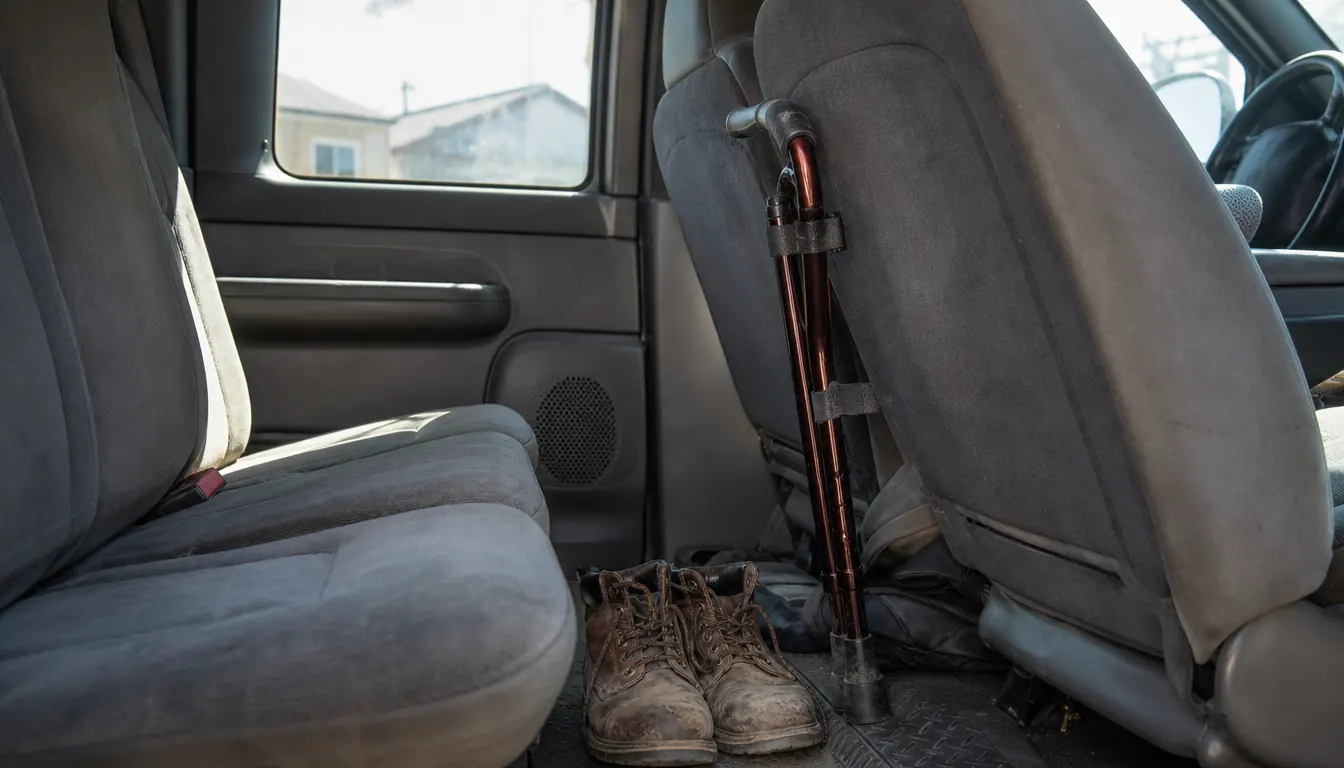
Step 4: Match the cane to the trip, not the trip to the cane
I own two walking aids and they do different jobs. The HONEYBULL is the short trip and Sunday cane. Church every Sunday. The hardware store. The three steps from the carport into the kitchen. The other one is a rolling walker with a seat on it, and that is for the grocery store with my wife, Wednesday morning coffee with the old route guys at the feed store, and the gravel drive down to the mailbox when it has rained.
The mistake I made early was trying to make one thing do both. A cane on wet gravel with a bag in your other hand is the wrong tool, and no amount of being careful fixes that. Ask the cane to do a cane's job. Short, flat, familiar ground with one hand free, and it is the easiest thing in the world. Long ground, wet ground, or a day when you are already worn out, and you want the seat.
Nobody hands you that rule. You either work it out on your own or you have one bad afternoon and then you work it out. I am telling you so you can skip the bad afternoon. There is no prize for making the harder tool work.
Step 5: Put it in the first step and the last step of the day
Steadiness problems do not happen in the middle of a room. They happen at the edges. Getting out of the truck. The first step out of bed in the dark. The turn from the kitchen into the hallway when both hands are full. Those are the places I put the cane, and I put it there before I needed it, not after.
Out of the truck, the cane comes out first. I set it on the ground and press down before I swing my legs around, and that is one extra second of my life. The three steps up from the carport have a handrail, so it is cane in the right hand, rail in the left, one thing at a time. The first step out of bed in the dark is a bed rail's job on my side of the bed, not the cane's, and I would not ask the cane to do it.
There is one more place it lives, and that is the tired evening. Around eight o'clock, if I have been in the garden all afternoon, I am a different walker than I was at noon. The cane stays by the back door and I pick it up for the trip down the hall to the bedroom. That is not a decline. That is just the shape of a day when you are 74.
None of this was automatic in a week. It took most of a year before reaching for the cane felt the same as reaching for my glasses. My wife says she can tell when I am tired because I start carrying it instead of using it. She is right, and now I use it.
What Else Helps
Shoes do more than people give them credit for. A soft slipper with no back on it and a cane are working against each other, and the cane will lose. I wear a shoe with an actual sole and a closed heel around the yard and into town, and by the end of the day my feet tell me the difference.
Light is the other one. The bulb over my carport steps was dim for years and I never noticed because I knew exactly where the steps were. I noticed when I stopped trusting my feet. A brighter bulb was a five minute job and it changed the way those three steps felt at seven in the morning.
And a reacher. I keep one beside my recliner and I have used it every single day since the surgery, for the paper off the porch boards, for keys, for laundry out of the dryer, for the low shelf in the cabinet. Bending to pick something up off the floor is the exact motion that got me into trouble in the first place, and a reacher removes it from the day.
Last thing. Have somebody look at your setup who is not you. My physical therapist saw in five minutes what I had stopped seeing in a year, and she was not polite about it. Your doctor or your physical therapist should be the one to say whether a cane is right for you and how to use it, not a man on a porch in Tupelo. But once they say yes, these are the habits that make it earn its place.
Set the height once, learn the fold, and get the walk off your mind
The HONEYBULL folding cane stands on its own beside the pew, folds to 12.5 inches behind the truck seat, and adjusts from 30 to 36 inches with a push button. Mine has been by the back door for a year.
Amazon Check Today's Price on Amazon →