

Sixteen months ago I traded a hospital loaner walker for a Drive Medical rollator with a seat, and I have used it three or four times a week ever since. Here is the part the product listing does not tell you. The walking is the easy part. The lifting is what I had to make peace with, and it took me a solid month.
I am 74 years old. I carried a rural mail route for thirty one years, and now I live outside Tupelo, Mississippi, in a one story brick ranch with three steps from the carport up to the kitchen door. My right hip was replaced about eighteen months ago. Since then my balance has been a little uncertain, worse when I am tired, worse in the dark, worse on uneven ground. My physical therapist moved me off the two wheel loaner at about six weeks and told me to look at four wheels with a seat on it. That is how the Drive Medical rollator ended up folded and leaning against the carport wall.
The Quick Verdict
Steady under my hands, wide enough to feel planted, and the seat earns its keep on a long morning. It is also twenty pounds, and twenty pounds has to come up into a truck bed at the end of every trip.
Amazon Check Today's Price →The seat is the reason this one stayed
Four wheels and a padded seat turn a grocery run into something I can finish. Check the height range and the listed weight before you order.
Amazon Check Today's Price on Amazon →How I Have Actually Used It
Wednesday morning is coffee with my old route buddies at the feed store. That is a concrete floor, one step at the door, and about forty feet of walking in a room full of men who do not look where they are going. The rollator goes with me. I park it beside my chair and it sits there like a piece of furniture until I am ready to leave.
Saturday is groceries with Doris. She pushes the cart, I push the rollator, and somewhere near the back of the store I sit down for a minute while she finishes the list. That seat is the whole reason I quit arguing with myself about buying a four wheel walker. With the loaner I would hunt for a bench or lean on the cart like a man who had given up. Now I sit down wherever I happen to be standing.
Then there is the gravel lane from the carport down to the mailbox, which is the closest thing I have to a daily test. It is packed gravel with loose spots and one dip where the water stands after a rain. The rollator rolls it fine if I go slow and keep both hands on. It does not roll loose garden soil or thick grass for beans. Nothing with small wheels does, and I do not hold that against it.
Sunday is church, and the rollator stays home. It goes in the truck bed on the other days, but a sanctuary with a narrow aisle and a hundred people turning around to shake hands is not a place I want to be steering twenty pounds of steel. I take a folding cane instead. If you are weighing one aid against two, that is the honest answer from my house: the rollator is the outing aid, and a cane is the Sunday aid.

What Twenty Pounds Really Means
The listing says twenty pounds, and it means twenty pounds. That number did not register with me until the first Wednesday I had to get it in and out of the truck by myself. My truck has a back seat and a bed. The rollator folds flat and goes in either one. Lifting it to tailgate height is a two hand job, and on a bad morning it is a two hand job I would rather not do.
What we settled into is this. On good days I load it myself. On days when my hip is talking to me, Doris lifts it, or I leave it in the bed and let Wade pull it out when he comes through from Saltillo. That is not a design flaw. It is what twenty pounds of steel is. If you are thinking about one of these, go stand in your own garage and ask yourself honestly whether you can lift a twenty pound bag of dog food to waist height, twice, every trip.
There are lighter rollators. I handled a couple at the clinic and read the listings on others. The light ones felt tippier under my hands, and I decided I would rather carry the weight than fight the wobble. A man at church went the other way and is happy as can be. We are both right for our own bodies, which is why I keep telling people to put their hands on one before they order.
One more thing about the weight. It is steady because it is heavy. I have leaned on it with both hands to catch myself and it did not tip out from under me. That is not a small thing when the whole point of buying it was that I stopped trusting my balance. If I could trade five pounds back and keep the same steadiness, I would do it tomorrow, but nobody has offered me that trade yet.
Twenty pounds is the honest number, and it is the number that decides whether this rollator lives in your carport or ends up in the shed.
The Width, the Brakes, and the Things Nobody Mentions
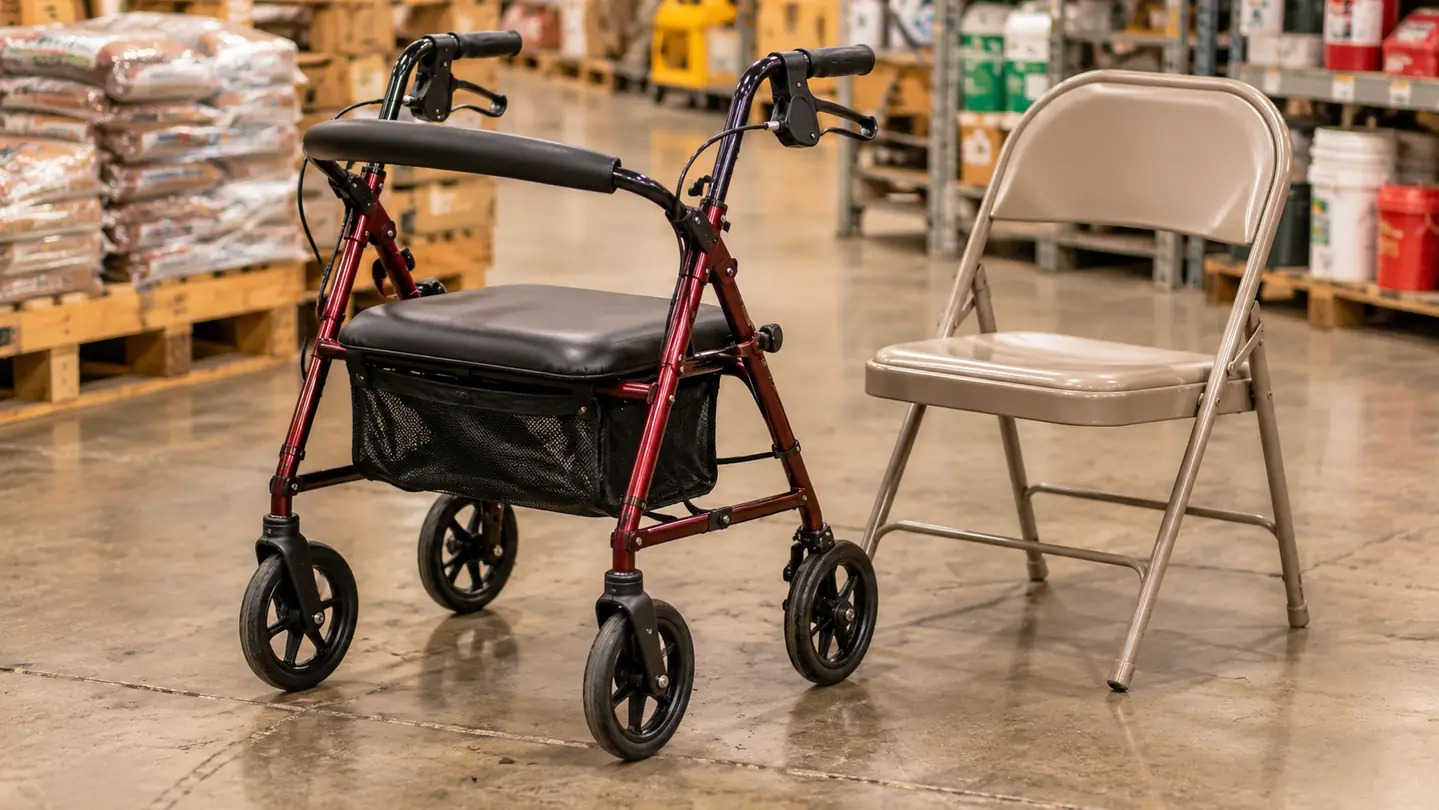
The listing gives the size as 25.5 inches deep by 21.5 inches wide by 34 inches high. Twenty one and a half inches is wide. It goes through the doors in my house, because the doors in my house are wide, but I have met doorways it did not want to go through, and I have turned it sideways in a store aisle more than once while somebody waited behind me. If your hallway is tight, measure it before you fall in love with the seat.
The 7.5 inch wheels are the part I would not change. They handle a store floor, a sidewalk, a parking lot, and my packed gravel. They do not handle the loose sand at the edge of the road or wet grass on a slope. If most of your walking is in a yard or on a lawn, understand going in that this is a pavement and packed surface tool. That is not a criticism. It is what it is built for, and pretending otherwise is how people end up disappointed.
It has hand brakes and they work, and my hands do not always cooperate with them. In the morning my fingers are stiff for the first hour. The levers want a firm squeeze, and that firm squeeze is the exact motion my hands are worst at before I have had my coffee. I start slow on the flat part of the lane and let my hands wake up before I get to the dip.
This is the one thing I would tell a stranger to test in the store. Sit down, put both hands on the levers, and squeeze them ten times in a row. If your grip is weaker than mine, or if you have arthritis in your thumbs, you will know in ten squeezes whether this is the right machine for you. My doctor told me to think about grip strength before I thought about anything else, and that advice was right. Ask yours the same question before you buy.
The Seat Is a Breather, Not a Chair
The seat is padded and it is comfortable for five or ten minutes. It is not comfortable for an hour. Getting up out of it is a lean forward and a push with your legs, and after a hip replacement that is a movement you want to have practiced before you need it in public. When I sit down I keep both hands on the levers and set my feet first. I do not drop into it. Sitting on a four wheel rollator is not like sitting in a kitchen chair, because the thing under you can move.
The back support folds up and lifts off. I leave it on, because with the back on it feels like a chair and I trust it more. If you are broader through the shoulders than I am, you may want it off so you can sit back without a bar behind you. Either way it takes about two seconds to change, which matters more than it sounds when you are the one doing the changing.
Where the seat really pays off is a long morning out. Two hours between the feed store and the grocery store is more than my hip wants to stand through, and four minutes of sitting in the middle of it is the difference between an outing I enjoy and an outing I endure. I have sat on it in a checkout line, in a parking lot waiting on Doris, and once in the produce aisle while a stock boy moved a pallet. Not one person said a word.
What I Compared It To, and What Has Held Up
What I had before this was a two wheel walker from the hospital equipment closet, on loan for the first six weeks after surgery. It is a fine thing for what it does. It is also the reason I understand why people give up on walking any distance. A two wheel walker makes you pick it up and set it down, over and over, it has no seat, and it does not roll. I returned it to the closet and have not missed it once.
I looked at four wheel rollators at the clinic and read a good many listings before I picked the Drive Medical one. What decided it for me was the stated 350 pound capacity, which told me the frame was not going to be the weak point, and the height adjustment lever, which meant my physical therapist could set it to me instead of me guessing. The listing also states a limited lifetime warranty. Sixteen months in I have not had to test that warranty, and I hope I never do.
What has held up is the frame, the wheels, and the brakes. What has changed is the padding on the seat, which has flattened where I sit, the way any cushion flattens. It is still comfortable for the five minutes I use it. The folding joint has stayed tight. The handles have not loosened. I wipe the wheels off with a rag when they come in muddy, and that is the whole of the maintenance I have done.
One thing nobody mentions is that the rollator marks you as a man with a rollator. People hold doors, which is kind, and people talk slower to you, which is not. I got used to it inside a month. If you are the sort who minds being fussed over, know going in that this is part of what you are buying, same as the wheels.
Getting the Fit Right Matters More Than the Frame
The rollator has a height adjustment lever, and the listing says it fits people from 59 inches tall up, with a maximum handle height of 35 inches. I am well inside that range. My physical therapist set mine, not me, and set it higher than I would have. Handles that are too low make you stoop, and stooping is half of what put me on a walker to begin with.
If you take one thing from this review, take that. The frame, the wheels, and the seat are the same for everybody who buys one. The height is the only part that is about you, and it is worth one appointment to get it right instead of guessing in your living room. Ask your doctor or your physical therapist about fit and use before you lean on it in earnest, and ask again in a month, because your strength will have changed by then.
While we are on fit, measure your car before you buy. The listing says 34 inches high and 25.5 inches deep, and that folded shape has to go somewhere at the end of the day. In my truck it goes in the bed. In a smaller car it would go behind the front seat, and I have my doubts it would go without the back support coming off first. Take a tape measure out to the carport. It costs nothing and it saves a return.
What I Liked
- Steady and planted under both hands, even on packed gravel
- Padded seat turns a two hour outing into something I can finish
- Height adjustment lever with a stated range from 59 inches up
- Hand brakes that slow it on the slope of my lane
- Folds and rides behind the front seat or in a truck bed
- Listing states a limited lifetime warranty and a 350 pound capacity
Where It Falls Short
- Twenty pounds is twenty pounds to lift into a truck twice a trip
- 21.5 inches wide is a tight squeeze in narrow aisles and doorways
- Brake levers want a firm squeeze, hard on stiff morning hands
- The seat is a five minute rest, not an all afternoon chair
- 7.5 inch wheels will not do soft ground or wet grass on a slope
Who This Is For
This is for the person who can still walk but no longer trusts the ground. Somebody whose balance went sideways after a surgery or a long winter, who wants four wheels and a place to sit when the morning runs long. If you are getting out to church, to the store, to a friend's porch, and the walk itself is the part you dread, this is a fair answer. It is also for the family member doing the buying. The twenty pound question is really your question, and it is worth answering honestly before you place the order.
Who Should Skip It
Skip it if you cannot lift twenty pounds twice a trip and there is nobody around to help you. Skip it if what you need is a walker to take your full weight, because this is a balance aid and not a replacement for whatever your therapist has you on. Skip it if most of your walking happens on grass, on gravel that has gone to mud, or in a yard full of roots. And skip the four wheel version entirely if your hallways are narrow, because 21.5 inches is a real number and it does not shrink for anybody.
Sixteen months in, it is still leaning by my carport door
It has not replaced a cane for Sundays and it never will. For the long mornings it does the job. Check the height range and the listed weight, and have somebody set the handles to you instead of guessing.
Amazon Check Today's Price on Amazon →