

I bought the FitPlus PowerGrip T9 about seventeen months ago, in the first weeks after my hip replacement, because my surgeon gave me one rule I could not break: no bending past a right angle. For a man who spent thirty-one years on a rural mail route, dropping things and picking them up without a second thought, that rule turned out to be the hard part of the whole business. Not the surgery. The bending. This grabber was the cheapest thing I bought for my recovery, and it is the only one I still pick up every single day.
Doris put it in front of me. Or Wade did. I honestly cannot remember which one of them thought of it first. What I do remember is the first morning I used it to lift the newspaper off the porch boards without crouching. I stood there in my robe, squeezed the handle, and the paper came up. No ceremony to it. But I went back inside, sat down in my recliner, and felt for the first time in about two weeks like the house was mine again instead of a collection of things I was not allowed to reach.
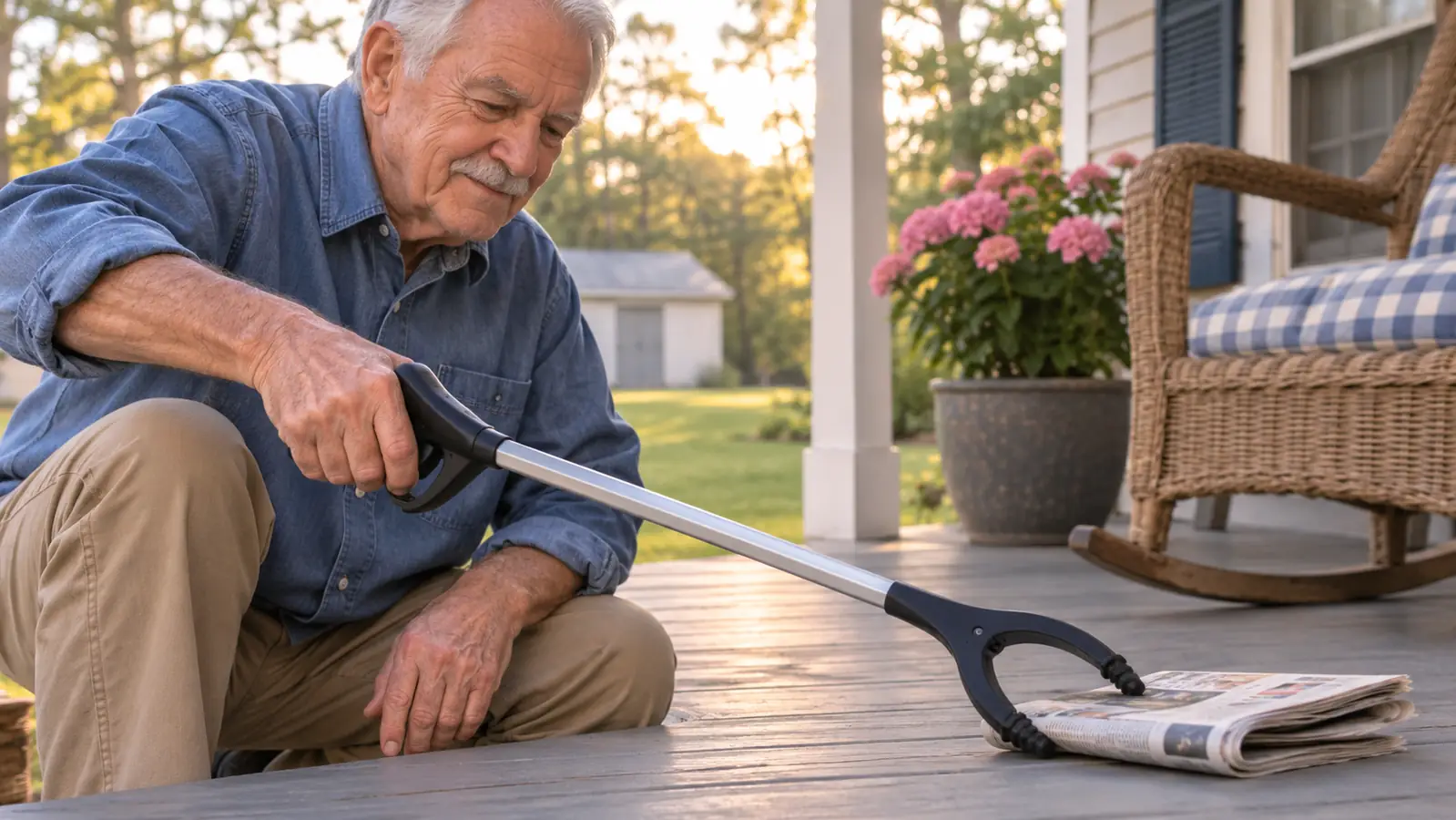
That is what you are really buying. Not the metal bar and the cable. The part where you stop asking your wife to fetch the remote off the floor.
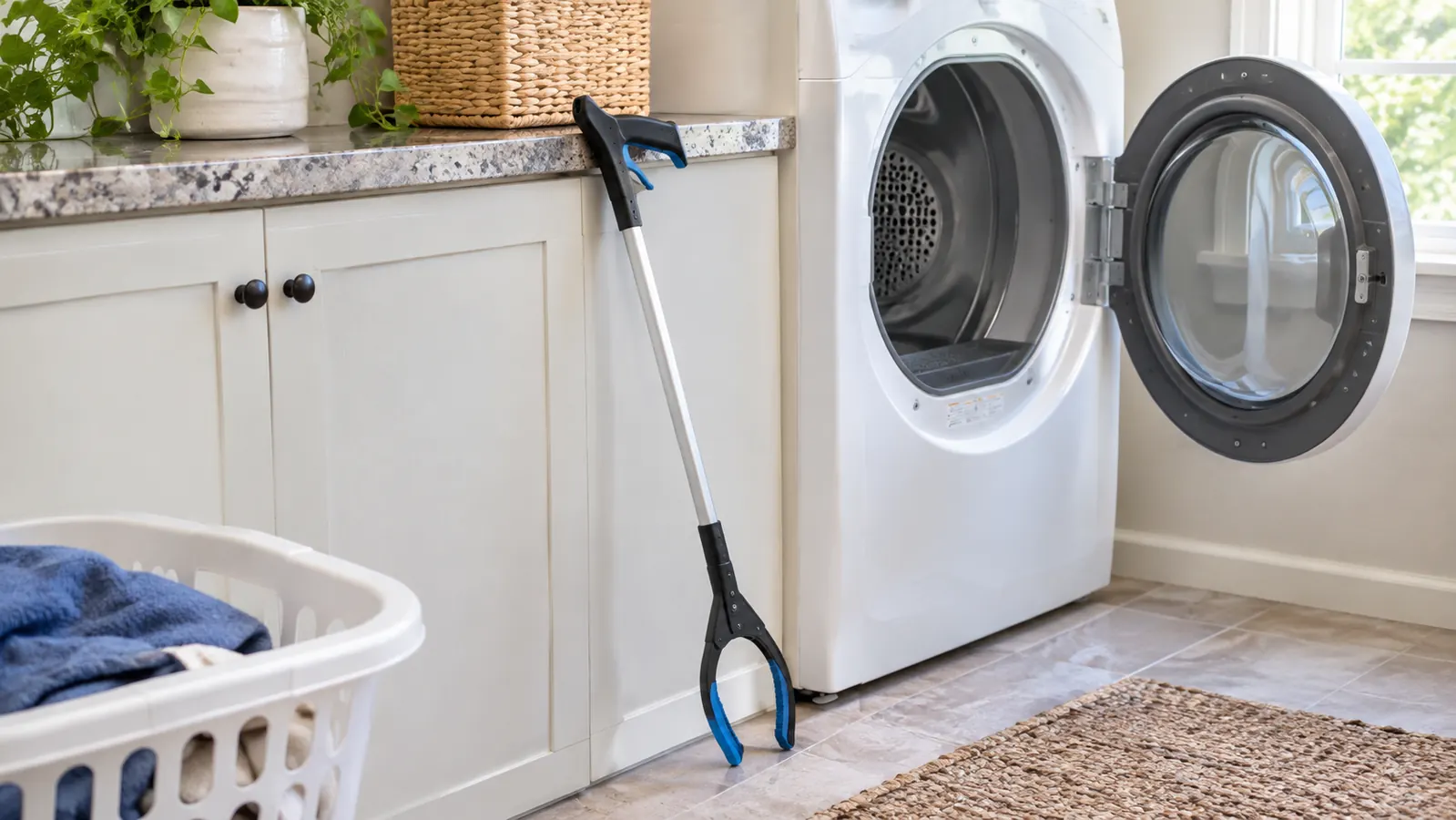
Here is what it actually does in my house. The newspaper off the porch boards every morning. Dropped keys. Coins, which I will get to. The little screws that work loose from my reading glasses. Laundry out of the dryer, which sits low and deep and is the worst thing in this house for a man with a new hip. The pickles on the back of the bottom cabinet shelf. The mail that slides under the carport door when the wind gets it. Socks that get away from me in the bedroom. It has a magnet on one end, and that magnet is the reason I can pick a dime up off the floor without getting down there with it. I did not expect to care about the magnet. I care about the magnet.
My hands are stiff in the mornings and have been for years. The handle on this one does not ask for a hard squeeze, and the jaw opens wide enough that I am not fighting to get it around a folded newspaper or a coffee cup that wandered off the counter. The ends are rubber-tipped, so a drinking glass does not slide out of it halfway to the sink.
Now the other side, because a tool that earns this much use deserves an honest accounting. It will not lift a gallon of milk. It will not hold a slick round thing that has no give to it. It does not aim itself, and you still have to look at what you are reaching for and think about where the jaws are going. I dropped a pill bottle with it twice before I learned to slow down. And the joint in the middle is the part I expect to wear first, the way any folding thing wears at the fold.
I have not had to ask Doris to pick a single thing up off the floor in seventeen months. That is worth more to me than anything in my shed.
The tool that got me through hip precautions, and then just stayed
Seventeen months in, the FitPlus grabber still leans against my recliner where I can reach it without standing up. If you are facing the same no-bending rule, this is where I would start.
Amazon Check Today's Price on Amazon →Seventeen months is a long time to keep using something you bought out of necessity. Most of the gear from those first weeks is gone. The FitPlus grabber stayed because it kept finding new work. I use it in the garden now to pick up a dropped tomato or a windfall pear without folding myself in half over the row. I use it to pull the shade down over the kitchen window when my shoulder is complaining. I use it to fish the remote out from between the cushion and the arm of the chair, which is a job I used to do with a broom handle and bad language.
There is a version of this story where I tell you it made me steady on my feet. It did not. It is a reaching tool, not a walking aid, and I want to be plain about that because I have read enough of these to know how they stretch. It kept me from breaking the rules my surgeon set. It kept me from crouching when I was not ready to crouch. The steadiness came later, from physical therapy and from time, and it came over weeks, not overnight.
What it did do, quietly, was take away a hundred small decisions a day. Every time something hits the floor, an older body runs the same quick arithmetic: is this worth the bend, is there something to hold on to, can it wait until somebody comes by. That arithmetic is tiring in a way I did not know how to explain to anybody. When the arithmetic goes away, you get some of your day back. You also get some of your temper back.
I keep it beside the recliner. That is the whole system. No hook on the wall, no drawer. If it lived in a drawer I would not use it, and I know that about myself at seventy-four.
What I'd Tell You If We Were Sitting at My Kitchen Table
I would tell you to ask your doctor or your physical therapist before you buy anything, including this. They know your hip, your balance and your house. I only know mine. I would tell you the reacher is not the thing that gets you back to church or out to the feed store on Wednesday morning. The walking aid does that. This is the tool that keeps you out of trouble in between, and it costs less than most of what gets handed to you in those first weeks.
And I would tell you not to wait for a surgery to get one. Doris has never had a hip replacement and she borrows mine to reach the top shelf in the pantry. If you are seventy-something and something rolls under the couch, you already know what the floor costs you. Keep one within reach of where you sit, and you will use it more than you expect.
One reacher, beside the chair, used every day for seventeen months
If you are working through hip precautions, or you are simply tired of the floor, start here. Ask your physical therapist about fit and use first.
Amazon Check Today's Price on Amazon →