
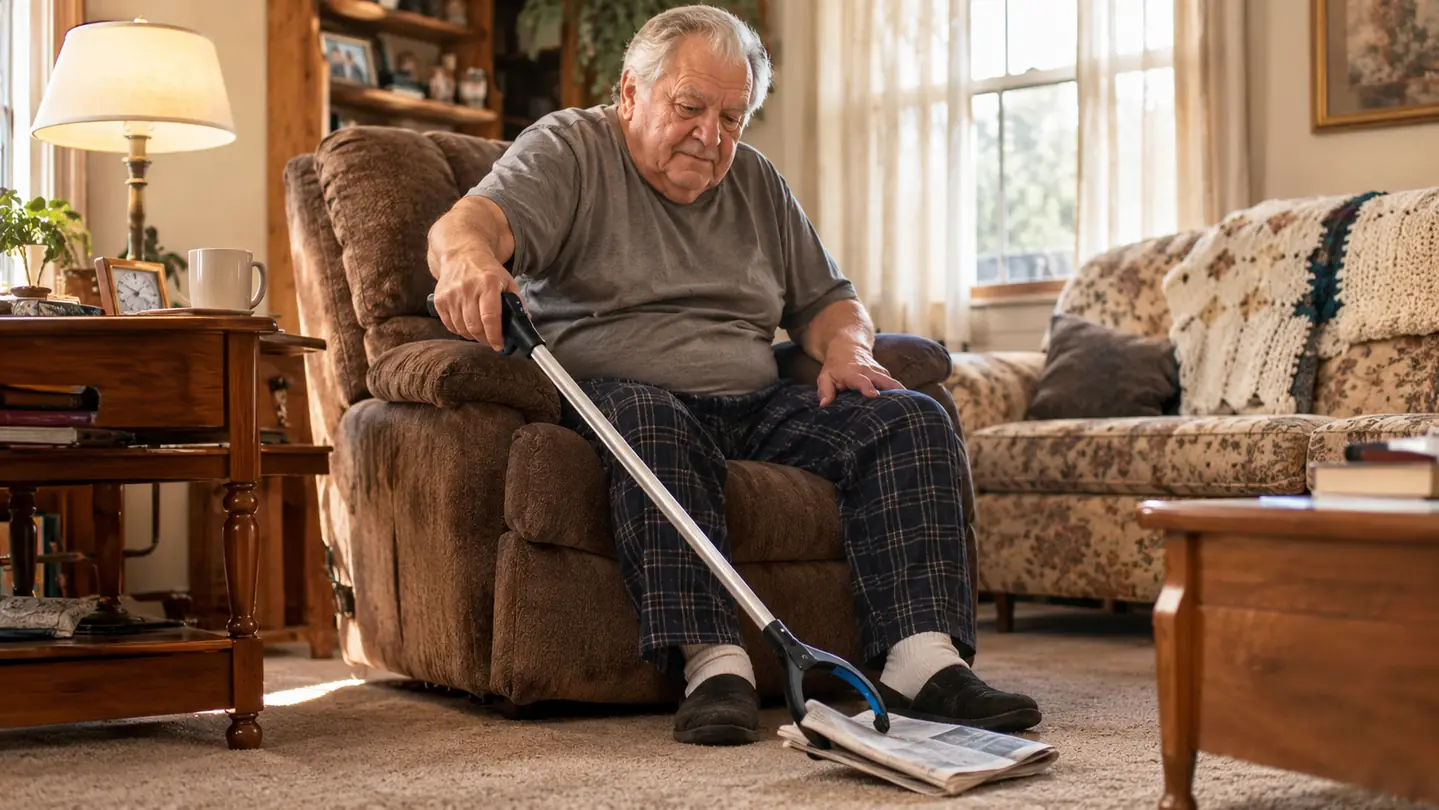
The reacher lives on the arm of my recliner. It has been there, more or less, for about 17 months. A hip kit sock aid, if I owned one, would be in a drawer by now, and that is most of the comparison in two sentences. I am 74, I drove a rural mail route for 31 years, and I had my right hip replaced in the spring about 18 months ago. My house is a one-story brick ranch outside Tupelo with three steps up from the carport to the kitchen door. I have had enough mornings in this body since the surgery to know which tool earns its keep and which one is a good idea that stops being needed.
So here is the short answer. Buy the FitPlus PowerGrip T9 reacher first. It is the tool that came into my day in the first weeks after surgery and never left it. A hip kit sock aid is a real tool and it does one job the FitPlus cannot do at all, which is put a sock on a foot you are not allowed to bend toward. But that job lasts about six weeks for most of us, and the reacher's job does not end. If you are buying one thing, buy the reacher. If you are facing hip precautions and there is nobody in the house to help you dress, get the sock aid too and do not feel silly about it.
| FitPlus PowerGrip T9 | Hip Kit Sock Aid | |
|---|---|---|
| Main job | Lifts what you drop: newspaper, keys, coins, laundry, things on low shelves | Gets a sock onto a foot you cannot bend toward |
| Reaching the floor | Does the job so you never bend past a right angle | Works only at your own foot |
| Grabbing hard objects | Wide jaw with rubberized ends, plus a magnet on one end | Fabric only, a sock stretched over the shell |
| Dressing yourself in the first six weeks | Cannot put on a sock at all | Puts on a sock with no help and no bending |
| Useful once precautions lift | Still in daily use 17 months on | Usually ends up in a drawer |
| Storing it out of the way | 16.5 inches, needs a wall or the arm of a chair | Small enough for a nightstand drawer |
| Taking it with you | Folds and rides behind the truck seat at 9.52 ounces | Not made to travel, it stays where you leave it |
| Who it suits | Anyone whose floor has become a place they visit carefully | Anyone inside hip precautions with no one home to help |
Tables are tidy and life is not. Which column matters to you depends on which week you are in. In week two after surgery the sock aid is worth more than the reacher, because you cannot get your own sock on and you are not going to ask your wife to do it forever. In week twenty, and in week seventy, the reacher is the only one of the two still working. That is the honest shape of it, and the rest of this is the detail behind it.
What the FitPlus Reacher Does in My House
I keep one reacher. Just one, beside the recliner, and I have never felt the need for a second. Mine came in the first weeks after the surgery, when my physical therapist was very clear about the precautions: no bending past a right angle, no crossing my legs, and no folding myself down to wrestle with a shoe. A grabber solves the bending problem without asking anything of the hip. The FitPlus has a wide jaw and a steel cable running down the shaft, and the ends are rubberized so a coin does not skate out of the grip. There is a magnet on one end, and I have used that more than I expected to.
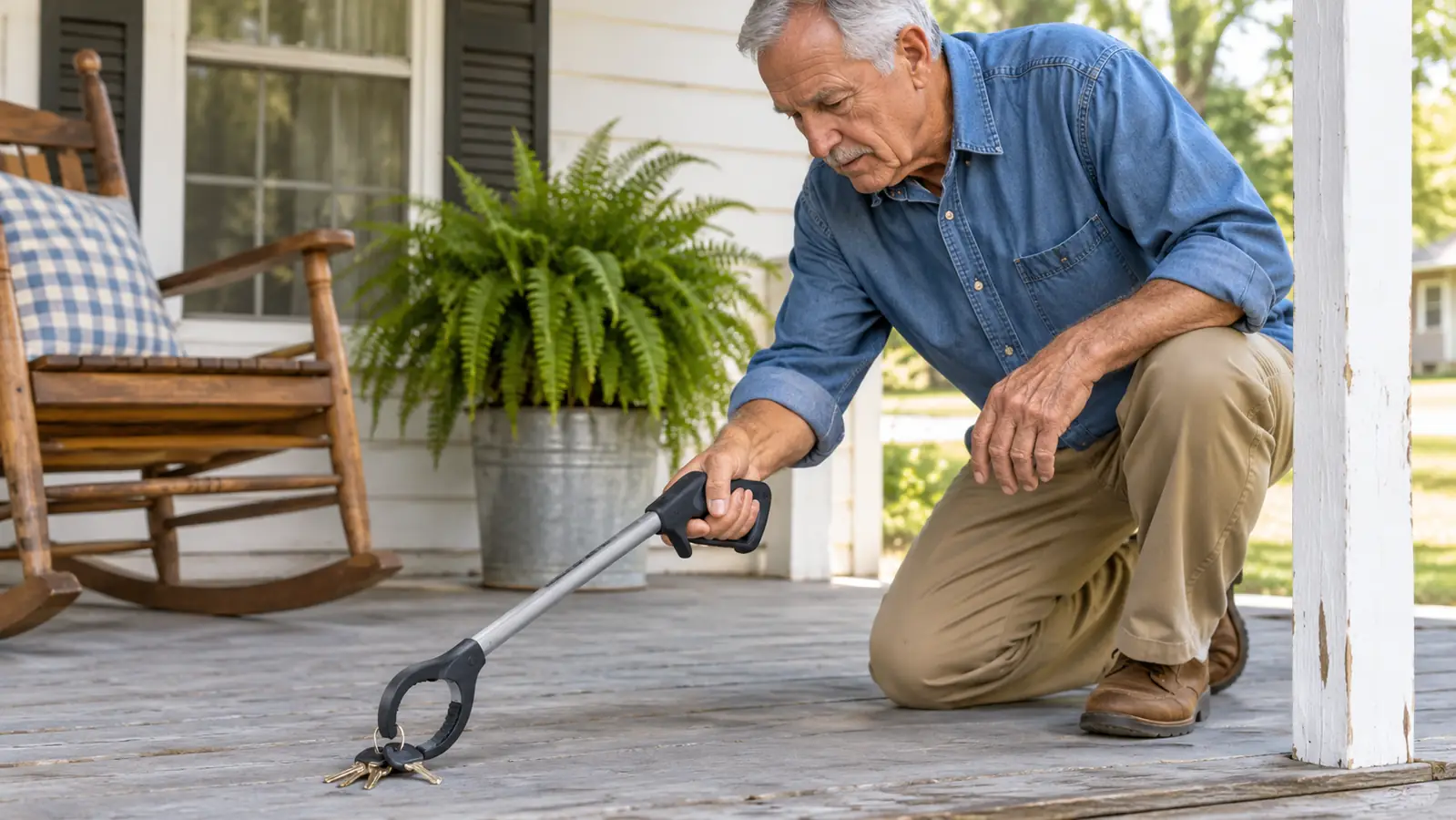
The newspaper is the everyday job. It lands on the porch boards and I am not walking out there in the damp to bend over for it. The FitPlus picks it up flat and I carry it in like that. Then there are the small things a 74-year-old man drops, which is everything: keys, coins, a screw, the cap off a jug of tea. The rubberized ends hold a quarter well enough that I can drop it in the jar by the door. The magnet handles what the jaw fumbles. I fished a lost screw out from under the workbench with it and I did not have to kneel down to do it, which at my age is the whole point.
The listing gives 16.5 by 5 by 0.1 inches and 9.52 ounces, and the fold is real. When Doris and I run to the grocery store I fold it and it goes behind the truck seat, and when I want it out of the way in the house I fold it and lean it against the wall. Nine and a half ounces does not sound like much until you have held your arm out with something heavier for a minute. I also use it on the low cabinet shelf in the kitchen where Doris keeps the good mixing bowls, because that shelf sits below my knee and I do not go below my knee if I can help it.
What a Hip Kit Sock Aid Does, and Why I Do Not Own One
I should be straight with you. I did not buy a sock aid and I have never used one in my own house. I saw them at the physical therapy clinic where I did my rehab, and a man at my church uses one every morning. So what follows is not a review from daily use. It is what I know from watching, and from the six weeks when I needed that kind of help.
A sock aid is a simple thing. It is a stiff half tube, usually with a terry cloth sleeve over it, and two long cords hanging off the sides. You load the sock over the outside of the tube, drop the tube on the floor in front of you, slide your toes in, and pull the cords so the sock rolls up over your heel and onto your foot. You do all of it sitting on the edge of the bed. Nothing about it requires you to bend past a right angle, which is why the hospital and the therapy clinic hand them out with hip kits.
What I did instead was ask Doris. For the first six weeks after my surgery she put my socks on for me every morning, and I will not pretend that was a hardship, but it was a thing I could not do for myself. Around week seven I started managing on my own sitting on the edge of the bed, and I have been doing it that way since. Not every man has a Doris. If you live alone, or if your wife has her own hip to think about, that sock aid is the difference between getting dressed by yourself and waiting for somebody to drive over.
Not every man has a Doris. If you live alone, a sock aid is the difference between dressing yourself and waiting for somebody to drive over.
Where the FitPlus Reacher Wins
It wins on the number of days it matters. The reacher has been in my life for about 17 months and I touched it this morning. The sock aid's window is the six weeks of precautions, give or take, and after that most people fold it into a drawer and forget where they put it. That is not a knock on the sock aid. It is a description of a single-purpose tool standing next to a tool that turns out to have a use in almost every room of the house.
It also wins on range. The sock aid only ever works at your own foot. The FitPlus works at the floor, under the sofa, behind the dryer door, down in the bottom of the closet, and on any shelf that sits below your waist. It picks up things that are not fabric. A sock aid cannot bring in the mail or fish a coin out from under the recliner, and the reacher in my house has done both this week. It folds, it weighs 9.52 ounces, and it goes where you go. The sock aid lives where you leave it.
Where a Hip Kit Sock Aid Wins
It wins the six weeks, and it wins them without argument. There is no version of the reacher that puts a sock on your foot. None. If you are inside the hip precautions and you live alone, the sock aid is not a nice extra, it is the thing that keeps you from asking a neighbor to dress you. I had another option and I took it. A man whose wife is not able to help does not have that option, and he should not feel one bit of shame about buying the tool that makes him independent.
It also stores better. My reacher is a long object that needs a wall or the arm of a chair, and when it is not folded it is in the way. A sock aid is small, it goes in a nightstand drawer and disappears, and in a narrow bedroom or a tight path around the bed that matters more than it sounds. It is also easier to explain to a visiting nurse than a grabber is, because everyone in that line of work already knows what it is for.
The one I still reach for, 17 months on
The FitPlus PowerGrip T9 has a wide jaw, a steel cable down the shaft, rubberized ends and a magnet on one end. It folds, and the listing puts it at 9.52 ounces and 16.5 by 5 by 0.1 inches. Mine has been beside my recliner since the first weeks after surgery.
Amazon Check Today's Price on Amazon →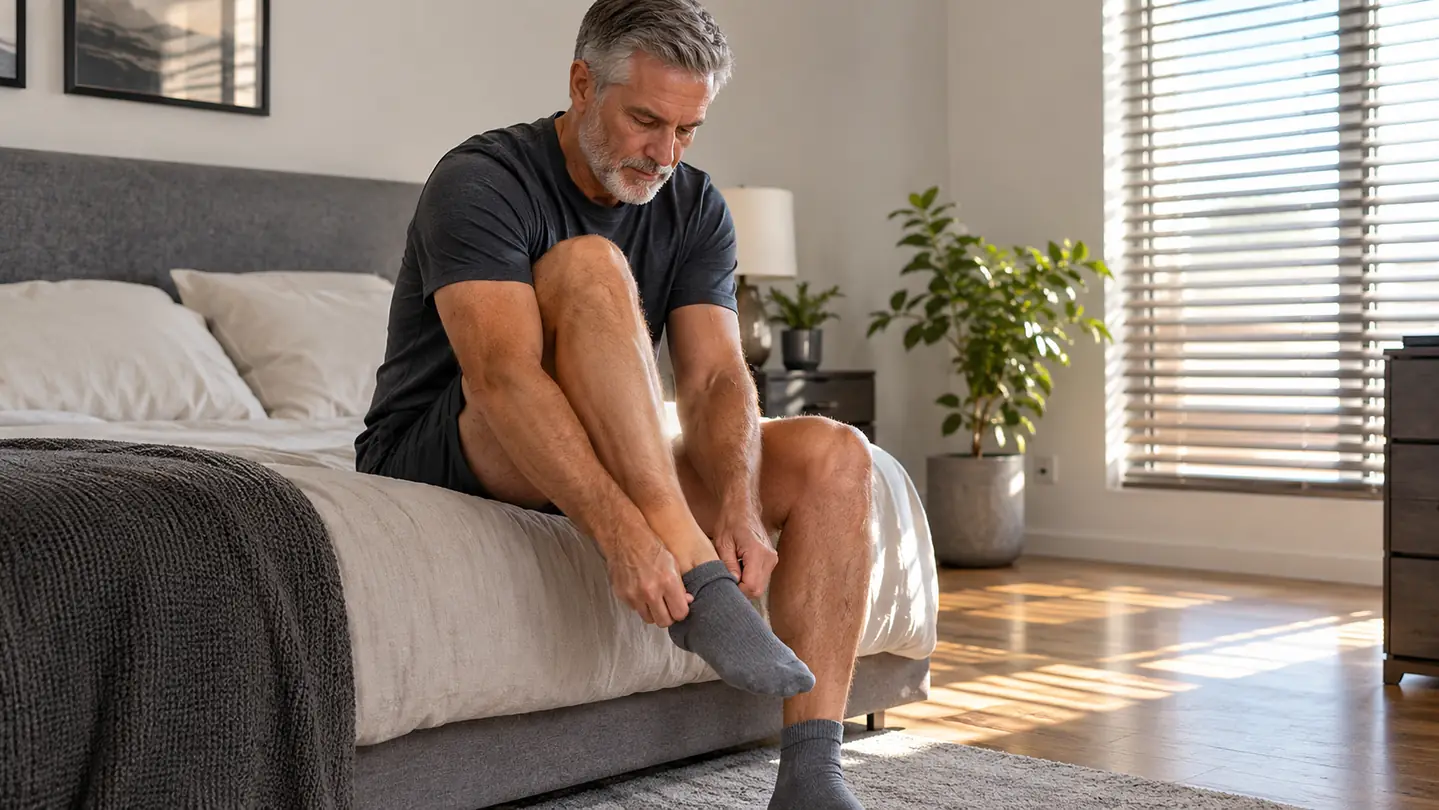
The First Six Weeks Against the Months After
If you are reading this before your surgery, the six weeks are what you cannot picture yet. You will be told not to bend past a right angle and not to cross your legs, and those two rules take away most of the ways a person normally gets dressed. Socks are the worst of it. Shoes are a problem too, but you can wear slip-ons. Socks are the thing everybody gets stuck on, which is why the hip kit exists and why the sock aid is in it.
The reacher covers the rest of that same stretch. I used mine for the newspaper, for the television remote when it slid off the arm of the chair, for a dropped pill bottle, and for pulling a pair of jeans up the last few inches. It kept me from breaking the precautions in a hundred small unthinking moments, which is how people get hurt. Not by doing something dramatic. By forgetting for one second and bending over because the thing was right there.
Then the precautions lift and the two tools go in different directions. The sock aid has done its job and it goes in the drawer. The reacher gets more use, not less, because you stop thinking of it as a surgery tool and start thinking of it as the thing that saves you a trip across the room and a slow careful squat. Mine moved from the bedroom to the recliner and it has not moved back. One of these is a season, and one of them is a habit.
What Neither One Will Do for You
Neither of these is going to steady you. If your balance is unreliable, a grabber and a sock aid are not walking aids and should not be used like one. I lean on a cane around the house and a rollator when I am out, and I asked my physical therapist before I put any weight through a grabber while standing. If you are unsteady on your feet, the conversation you need to have is about a cane or a walker, not about which reacher to buy.
Neither one replaces the therapy either. My steadiness came back over weeks of doing the exercises, not from a tool. What the tools did was let me keep my precautions and keep my dignity while the exercises took effect. That is a smaller claim than some of what you will read, and it is the true one. Ask your doctor or your physical therapist about fit and use before you lean on anything new, a grabber included.
Who Should Buy Which
Buy the FitPlus reacher if you are heading into hip surgery or working your way back from it, or if you are simply at the age where bending over for the paper has stopped being a good idea. Buy it if your hands are stiff in the mornings and the floor has become a place you visit carefully. Buy it if you want one tool that sits by the chair and handles the small daily fumbles. Buy it first, because it is the one that will still be in the room a year from now.
Buy a hip kit sock aid if you are inside the precautions and there is nobody at home to help you dress, or if the person who would help you has her own shoulders and hips to protect. Buy it alongside the reacher rather than instead of it, because they do different jobs and the six weeks are not the same as the months after. If you can only have one and your surgery is still ahead of you, get the reacher now and ask the hospital about a sock aid, because they very often hand them out.
Start with the tool that outlasts the six weeks
Wide jaw, steel cable, rubberized ends, a magnet on one end. Folds for the truck and weighs 9.52 ounces on the listing. Mine has been on the arm of my recliner for about 17 months and it was in my hand this morning.
Amazon Check Today's Price on Amazon →