
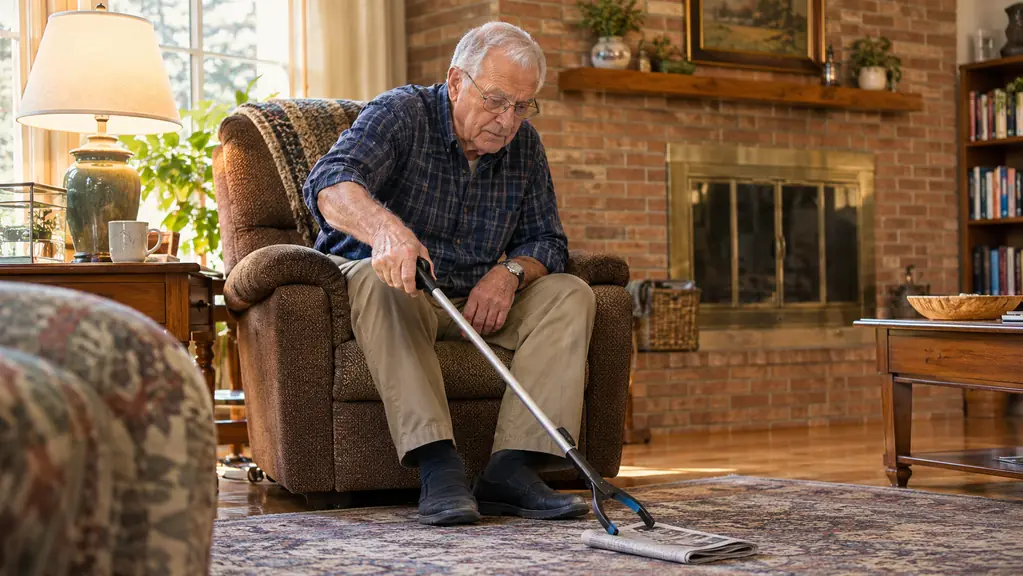
The first thing I dropped after my hip replacement was the television remote, and it went behind the recliner where a man my age cannot see it without lying down on the floor. I bent over to get it anyway. My physical therapist had told me not to bend past a right angle, told me twice, and at 74 a habit is stronger than an instruction. Nothing tore that afternoon. But I sat back in the chair and thought about how close that was, and the next week there was a reacher in the house. That was about 17 months ago. It has not moved far from that chair since.
If you are reading this because bending over has gotten expensive, you have already tried the free fixes. Scooting something to the edge of the counter with your toes. Hooking a cane handle under a fallen sock. Asking your wife to fetch it, which works fine until the afternoon she is out and you are on your own. None of that is stupid. It is just narrow. A reacher is the plain answer, and the FitPlus PowerGrip T9 is the one I know. Foldable, steel cable, a wide jaw, rubber-tipped ends, and a magnet on one end. It is not a complicated tool. But there is a right way to use one and a way that will put you on the floor, and the difference is almost all in the technique.
The grabber that kept my hip precautions honest
Steel cable, wide jaw, rubber-tipped ends, and a magnet on one end. The FitPlus PowerGrip T9 has lived beside my recliner for 17 months and folds small enough to ride behind the truck seat. Today's price is on the listing.
Amazon Check Today's Price on Amazon →Five Steps I Would Teach Anybody With a New Hip
What follows is not theory. It is what I worked out in my own kitchen and yard over a year and a half, mostly by doing it wrong first. If your doctor or physical therapist gives you different instructions, theirs win. Mine are a starting point for a conversation, not a replacement for one.
Step 1: Learn the jaw on something soft before you need it
A reacher is not a hand. It has no sense of touch, so the first ten minutes should be spent picking up things that do not matter if you crush them or drop them. A rolled pair of socks. A sponge. A loaf of bread. The FitPlus has a wide jaw and rubberized tips, and the cable in the handle means you squeeze at one end and the jaws close at the other, so you have to learn how hard you need to squeeze. Too soft and the object slides out halfway up. Too hard and you have mashed a tomato you were planning to slice.
My hands are stiff in the mornings, and that is worth knowing about yourself before you try to lift a glass jar off a low shelf. Test your grip on a light morning before you trust it. If your hand will not hold the squeeze, do not talk yourself into it because you are in a hurry. Set the object down and come back at noon when the hands have loosened up.
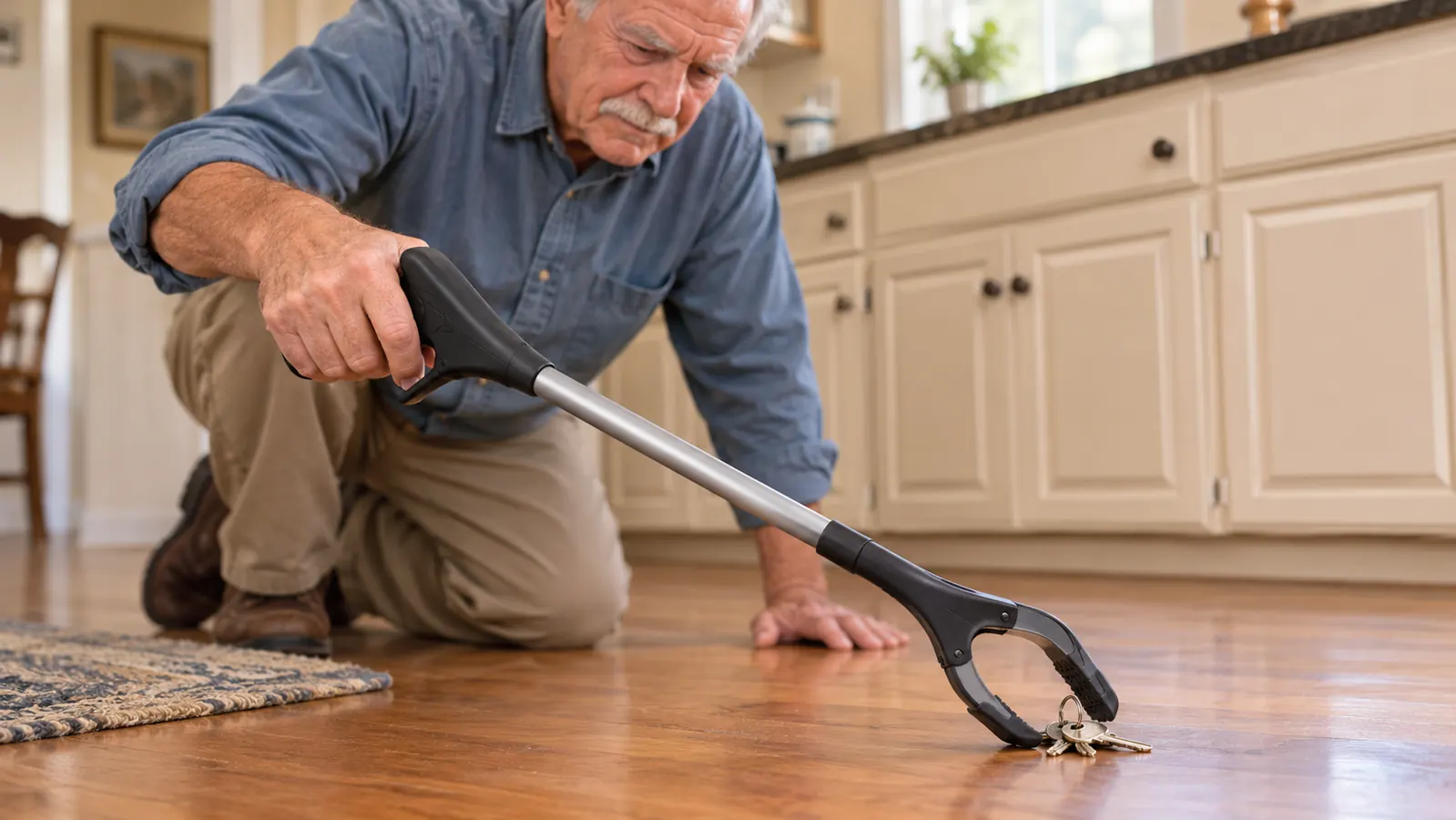
There is a magnet on one end of this tool, and it is the part I use most. Keys off the porch boards, a screw that rolled under the workbench, a paper clip, the little metal tab off a battery door. You do not have to open the jaws at all. Touch the magnet, lift, done. That is the smallest feature on the tool and the one that has saved me the most bending.
Step 2: Turn your whole body instead of reaching across it
The way most people get hurt with a reacher is not the tool itself. It is the twist. They keep their feet planted and reach across their body for something on the far side, and all the weight shifts onto the hip that was operated on. I did this in the kitchen for about a week before I caught myself doing it. Now I turn. Feet first, then shoulders, then the arm. It looks slower than it is. It costs about two extra seconds.
Stand with your feet a little wider than feels natural and put your free hand on something solid. The counter, the back of a chair, the door frame. The reacher only needs one hand, which leaves the other one free to keep you honest. That hand on the counter is worth more than any feature on the tool.
If you are picking something up while seated, keep both feet flat on the floor and do not tip the chair back onto two legs. I have watched men do that in a feed store parking lot and it has never once ended well.
Feet first, then shoulders, then the arm. It looks slower than it is. It costs about two extra seconds.
Step 3: Sit down for anything below your knees
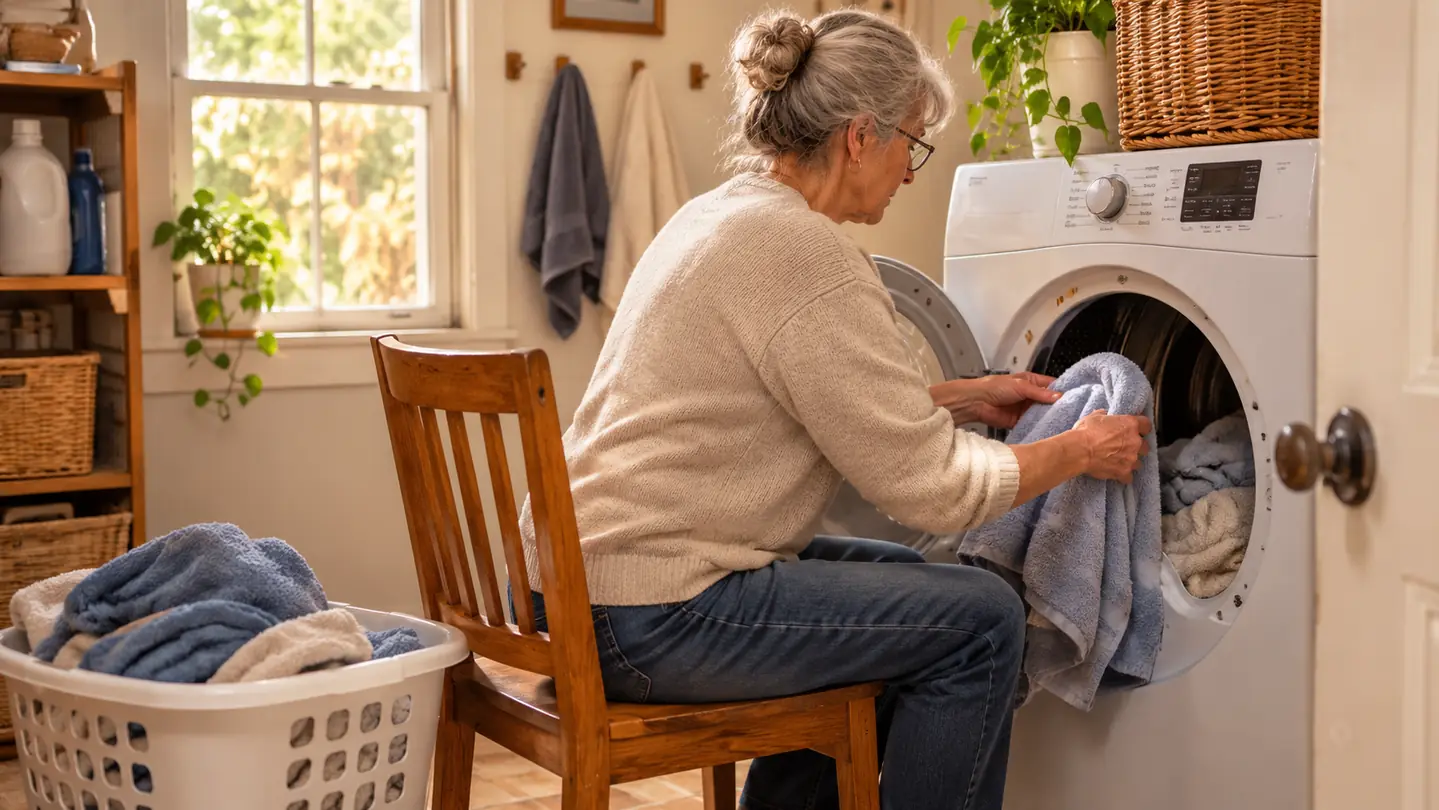
Anything on the floor or in the bottom third of a cabinet is a sitting job, not a standing job. The laundry in the dryer is the one that matters in my house. I pull a kitchen chair over, sit down, and work the clothes out with the reacher instead of folding myself into the drum. Same story with the low shelf under the sink where my wife keeps the dish soap, and the bottom shelf in the pantry where the big cans live.
There is a move people do where they keep both legs stiff and hinge at the waist, trying to keep the back straight. It looks athletic. It also puts nearly the same bend in nearly the same place, with more strain in the low back on top of it. Sitting beats it every time, and a kitchen chair is easier to find than a second surgery.
While you are down there, take two trips instead of one. Carrying a laundry basket in one hand while you steady yourself with a reacher in the other is a good way to lose your balance in a doorway. Take the basket to the table first. Then go back for the rest.
Step 4: Use the magnet for the small things you drop most
Coins and keys are the obvious ones, but the objects that cost you are different. A pill that rolled off the bathroom counter. A hearing aid battery. A screw from the handle of the screen door. Those are the ones you will be tempted to kneel for, and kneeling is exactly what you have been told not to do. Keep the reacher where you use it, not where it looks tidy. Mine leans against the wall beside the recliner, because that is where I am when something falls out of my shirt pocket. A reacher in the hall closet is a reacher you will not go fetch at nine at night.
If the object is metal, the magnet end handles it with no squeezing at all. If it is not metal, come down over the top of it and close the jaws. Do not come at it from the side. A coin or a button will slide out of a side grab nearly every time, and then you have chased it under the stove.
One caution from my own kitchen. Do not use a reacher to move anything hot or anything full of liquid. A grabber is steady for a sock and not steady for a coffee cup, and the burn is not worth the saved bend.
Step 5: Fold it and take it with you
The FitPlus folds, and the listing gives it as 16.5 by 5 by 0.1 inches at 9.52 ounces. That means it goes behind the truck seat and I forget it is there until I need it. I take mine out to the garden, because that is where I drop things. A trowel. A glove. A seed packet that the wind took off the tailgate. Wade loaded a load of mulch for me last spring and I did not get down on my knees once.
Weight matters more than people expect. Nine and a half ounces does not sound like much until you are holding it out at arm's length for a minute while you work something loose from a shelf. If your shoulder is not what it was, bring the object closer to your body before you lift, or use both hands on the handle for the stubborn pulls. There is no prize for doing it one-handed.
And then leave it out. A folded reacher in a drawer is a folded reacher you will skip. Mine stays open beside the recliner all day and only gets folded when it travels. The tool does no good folded in a closet, and neither does the advice.
What Else Helps
Good light, first of all. Half the things I have dropped in the last year went down in a dim room, and I could not find them because I could not see them. A lamp beside the chair and a brighter bulb out in the hallway cost almost nothing and saved me more bending than the reacher did. You cannot pick up what you cannot see.
Shoes with a real sole, even in the house. Socks on a wood floor after a hip replacement is a gamble I stopped taking about a year ago. If you want one more thing to ask your physical therapist about, ask about grab bars in the bathroom and about how to set the height on anything that adjusts. That is a conversation, not a purchase.
Ask before you need to. That is the least popular piece of advice I give, and the one I believe most. My son lives about 30 minutes away in Saltillo, and he would rather drive over on a Saturday afternoon than get a call from the hospital. A reacher is not there so you never ask for help. It is there so the small things do not pile up into a reason to ask, and so the asking can stay small.
If you have not bought one yet, the FitPlus PowerGrip T9 is the one I can speak to, because it is the one that has been in my house for 17 months and the one I still reach for. There are cheaper grabbers on the shelf and there are fancier ones. What I wanted was a tool that opened when I squeezed, held what I grabbed, and did not make me think about it. That is what this one has done.
Buy the tool once, then practice the five steps
The part that keeps you off the floor is technique, not hardware. But the hardware has to hold. The FitPlus PowerGrip T9 folds, reaches, and carries a magnet on one end for the keys and coins.
Amazon Check Today's Price on Amazon →