
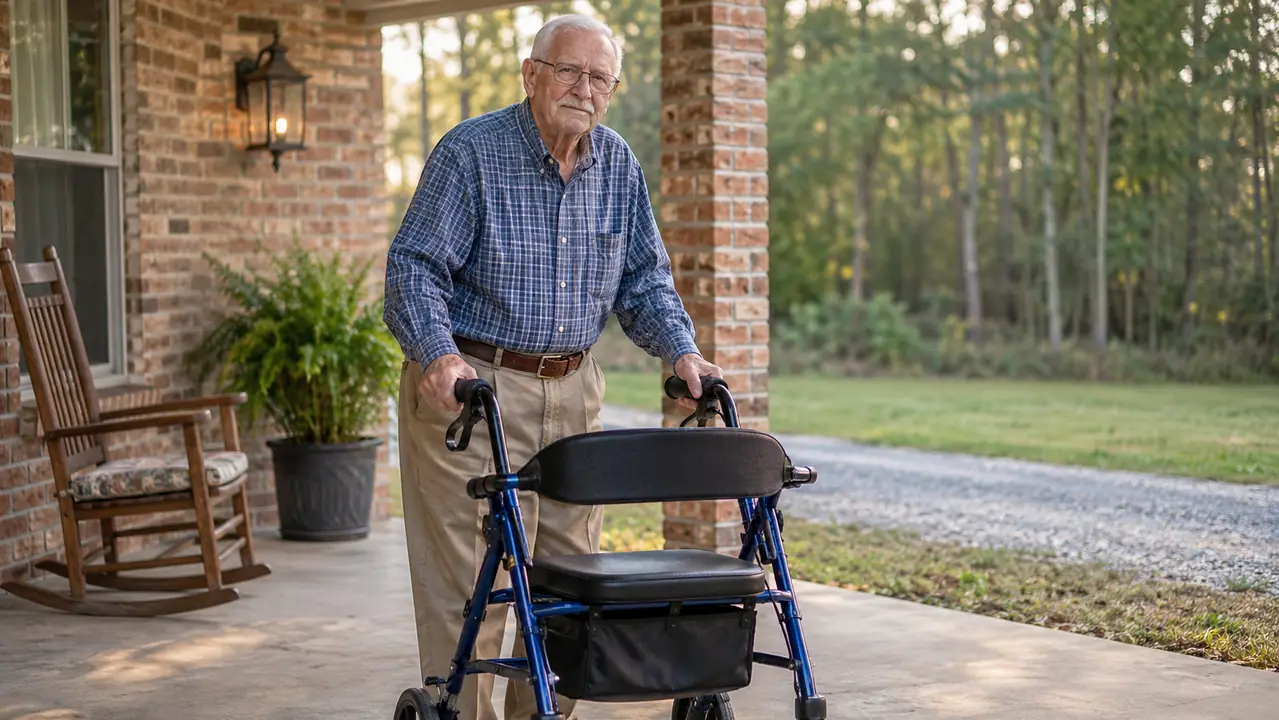
Nobody warns you that the walking gets shorter before it gets easier. Eighteen months after my right hip replacement, I could still get around my place outside Tupelo without much fuss, but the distances had quietly shrunk. The mailbox at the end of the gravel lane used to be a nothing trip. Then it became a trip I planned around the heat. Then it became a trip I skipped. I am 74 years old, I carried mail on a county route for 31 years, and I know exactly what happens when a body stops moving. The stopping gets easier and the moving gets harder.
What changed it was a physical therapist who took away the loaner two-wheel walker I came home with and moved me behind a four-wheel rollator with a seat. The one I have used for about the last 16 months is the Drive Medical rollator walker with the padded seat, the fold-up removable back support and the 7.5 inch wheels. I will not tell you it made me twenty years younger. I will tell you it took the worry out of the far end of the lane, and the worry was the thing actually limiting how far I walked.
The seat is the reason the walk gets longer
A four-wheel rollator with a padded seat lets you stop and rest without hunting for a bench. Steel frame, about 20 pounds, folds for the truck, and the listing puts the maximum weight capacity at 350 pounds.
Amazon See the Drive Medical Rollator on Amazon →The Five Steps, In the Order I Did Them
None of this is complicated. It is just a matter of doing the small things in the right order so you are not learning two lessons at once. Learn to stand behind the thing before you learn to cover ground with it.
Step 1: Set the Handles Before You Walk a Single Block
The handles adjust with a lever, and the listing puts the maximum handle height at 35 inches, with a minimum height recommendation of 59 inches for the person using it. Those two numbers matter more than anything else on the box, and they matter before you take a single step. If the grips sit too low, you will hunch over them, your shoulders will climb toward your ears, and twenty minutes of that will wear you out faster than the walking itself. I learned that with the loaner walker, which was set for a man a couple of inches shorter than me.
My physical therapist set mine in the clinic, and I put a mark on the leg so I could find the spot again if it ever moved. She had me stand tall with my arms hanging at my sides, then set the grips so my hands rested on them with a slight bend at the elbow. Shoulders down, not up. That is the whole test, and you can run it yourself in the carport in about a minute. If you have not had yours set by somebody who does this for a living, ask your doctor or your physical therapist to look at it before you take it out on the road. Five minutes of that is worth more than a month of guessing.
The back support folds up and it lifts off the frame, and I keep mine up. It gives me something to lean into when I sit and it keeps me honest about standing straight when I walk. Small thing. It adds up over a mile, and it adds up more on the mornings when my hip is stiff and I want to curl around the handles like a question mark.
Step 2: Learn the Brakes on Flat Concrete, Not on Gravel
The rollator has hand brakes, one on each side, and they are not decoration. Before I took mine off the concrete, I spent two afternoons squeezing them, walking ten feet and stopping, over and over, until stopping was a habit instead of a decision. That sounds like a waste of two good afternoons. It is not. A brake you have to think about is a brake that arrives half a second late, and half a second is the difference between a wobble and a fall.
Then I practiced slowing down on the slope between the carport and the kitchen door, the stretch above the three steps with the handrail. Then on the gravel lane. Gravel is where a rolling walker wants to run a little, and where a person who has not learned the brakes will get surprised. The 7.5 inch wheels roll over loose stone better than the small wheels on the two-wheel walker I had before, and that is exactly why you have to learn to hold them back. Better rolling is a fine thing right up until it is not.
Here is the rule I made for myself. I squeeze both handles any time I turn around, any time I sit down and any time I start moving again. It is like checking the mirror before you back the truck out. You do it every single time so that you never have to think about it, and so that the one time it matters you have already done it a thousand times.
Step 3: Sit Down Before You Are Tired, Not After
This is the step that changed my distance more than any other, and it is the one people resist. The padded seat is not there for emergencies. It is there so you can take two minutes at the halfway point and still have legs for the walk home. Before the rollator I would push until I was done in, and then the last stretch back was miserable and honestly a little frightening, because that is when I get unsteady. When I am tired.
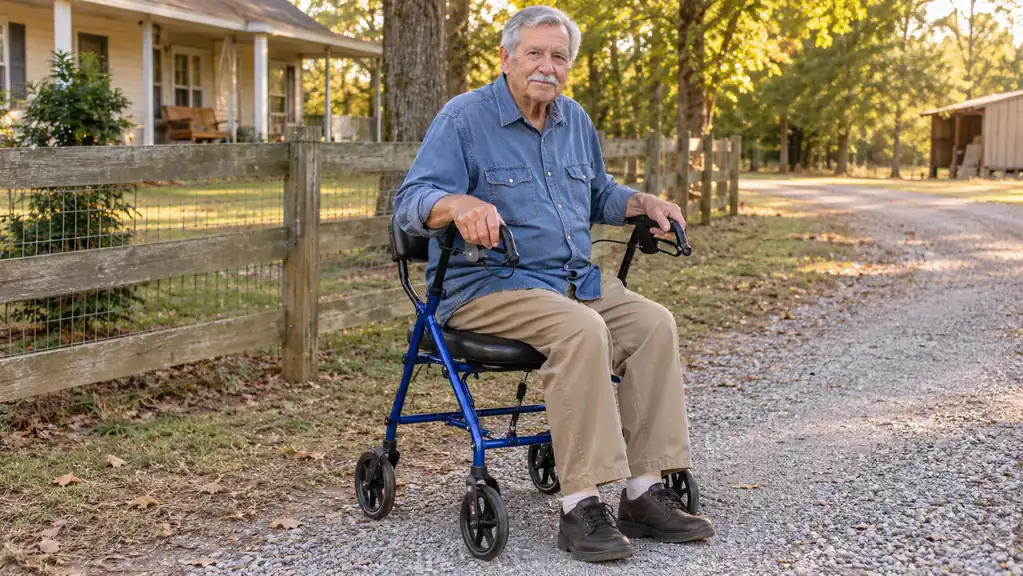
I sit at the fence corner now, both feet flat on the ground, hands on the brake handles, back against the back support. Two minutes. Then I stand up slow and finish the loop. My wife Doris can tell when I am about to overdo it before I can, and she is usually right, so I have learned to sit at the first sign of tiredness rather than the second. If you have somebody at home who notices things, listen to them. It is cheaper than being stubborn.
The other thing the seat does is let you go places with no benches. A waiting room. The feed store when the line at the counter is long. The far end of a parking lot. You always have a place to put yourself down, and knowing that changes how far you are willing to start out.
I sit at the fence corner for two minutes and then I walk back. Before the seat, I never got to the fence corner at all.
Step 4: Add Distance in Small Bites, Week by Week
Confidence comes in days. Distance comes in weeks. Do not mix those two up or you will set yourself back. The first two weeks I went from the carport to the porch post and back, which is not much of a walk at all, but it was a walk I did every day without dread. Dread is the thing you are actually training yourself out of. The muscles come along behind it.
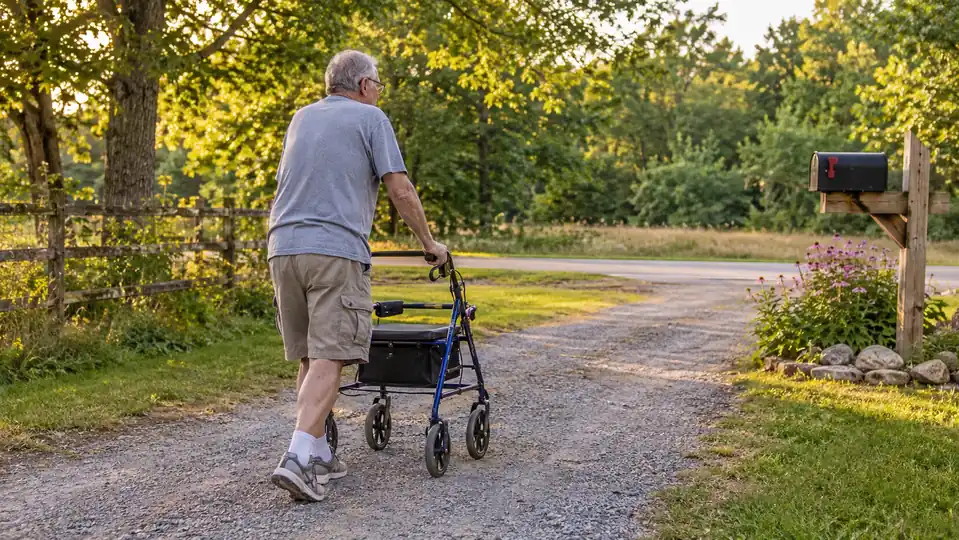
Week three I added the lane out to the mailbox. Week five I went past the mailbox to the fence corner. Somewhere around week seven I noticed I was not counting steps anymore, and that is the whole point. The day you stop keeping score is the day the walking has become ordinary again, and ordinary is what you are after.
There is a catch and I will say it plainly. A bad week will take some of it back. A cold, a poor night of sleep, a hot Mississippi afternoon, and you will find yourself short of breath at the mailbox again. That is not failure. That is just how an older body works. You start the ladder one rung up from where you started the first time, and you climb back.
Step 5: Plan the Outing Before You Leave the House
The Drive Medical rollator weighs about 20 pounds and it folds. That matters because everything I own that travels goes behind the front seat of the truck or in the bed, and I am not lifting 20 pounds into a truck bed on a morning when my hip is talking to me. Doris lifts it when I am tired. Wade, my son, does it when he is over from Saltillo. Otherwise I do it, and I do it before I am worn out rather than after. Load the gear first and sit down second.
Wednesday morning coffee with my old route buddies at the feed store is the outing I care about most. The rollator handles those concrete floors and the gravel lot out front without complaint, and it gives me a seat if the counter is busy. The grocery store with Doris is the other one. The frame is 21.5 inches wide, so it goes down an aisle without me turning sideways and apologizing to everybody behind me.
One thing I will say out loud. The rollator stays in the carport on Sunday. I use a folding cane at church, and it stands up by itself beside the pew. Different tool, different job. Giving the rollator a job it does not need to do just means I leave it home more often, and an aid that stays home is not helping anybody.
What Else Helps
The rollator is the center of it, but it is not the whole of it. Steady walking is a handful of small things working together, and the ones below cost you almost no trouble at all.
Do the homework your physical therapist gives you. Mine handed me a short list of standing exercises and I do them at the kitchen counter while the coffee is going. Boring work, done in a few minutes, and it is a good part of the reason the walking got easier. Ask your doctor or your physical therapist what is safe for you, because nobody on a website can tell you that.
Wear shoes with a firm heel and a real sole. Slippers on a gravel lane are how people end up on the ground. Turn the carport light on before you go down the three steps, not after. Keep a reacher within arm's reach so you are not bending for the newspaper off the porch boards, dropped keys, or the laundry at the bottom of the dryer. And ask somebody in the house to tell you the truth about when you look tired, because you will not notice it yourself.
The last one is the least popular and the most useful. Use the thing every day, not just on the days you feel shaky. A rollator that only comes out when you are already worn down is a rollator that shows up too late to do its job.
Fifteen minutes a day at first, with a seat waiting at the far end
The Drive Medical rollator walker with seat folds for the truck, is listed to hold up to 350 pounds, and carries a limited lifetime warranty. It is the aid that got me past the mailbox again.
Amazon See Today's Price on the Drive Medical Rollator →