

The morning after I nearly went down in the dark, I sat on the edge of my bed for a good ten minutes with my heart going and thought about how stupid it would be to break a hip at seventy-four after working thirty-one years on a rural mail route without so much as a sprain. I had gotten up to use the bathroom around two in the morning, no light on because I know my own bedroom, and my right leg did not come with me the way it should have. I caught myself on the nightstand. No fall. But my hand shook on that lamp for a while afterward.
The next morning my son Wade came over and we put the Medical king bed assist rail on my side of the bed. That was about ten months ago. I have grabbed that hand bar every single morning since, and every time I get up in the night, and I can tell you plainly what it has done for me and what it has not.
The Quick Verdict
It does one job and does it well: it gives you something solid to push against when you swing your legs out of bed. Ten months in, mine has not shifted, wobbled or needed a single adjustment. It will not replace a walker and it will not help you if your mattress will not take it. Ask your doctor or physical therapist whether it fits your situation before you order one.
Amazon Check Today's Price →The thing my hand found at 2 a.m. when my leg didn't show up
Slides under the mattress, strap holds it, adjustable height, no tools needed to assemble. It weighs about 6 pounds, and Wade had mine on the bed in about ten minutes.
Amazon Check Today's Price on Amazon →How I've Used It
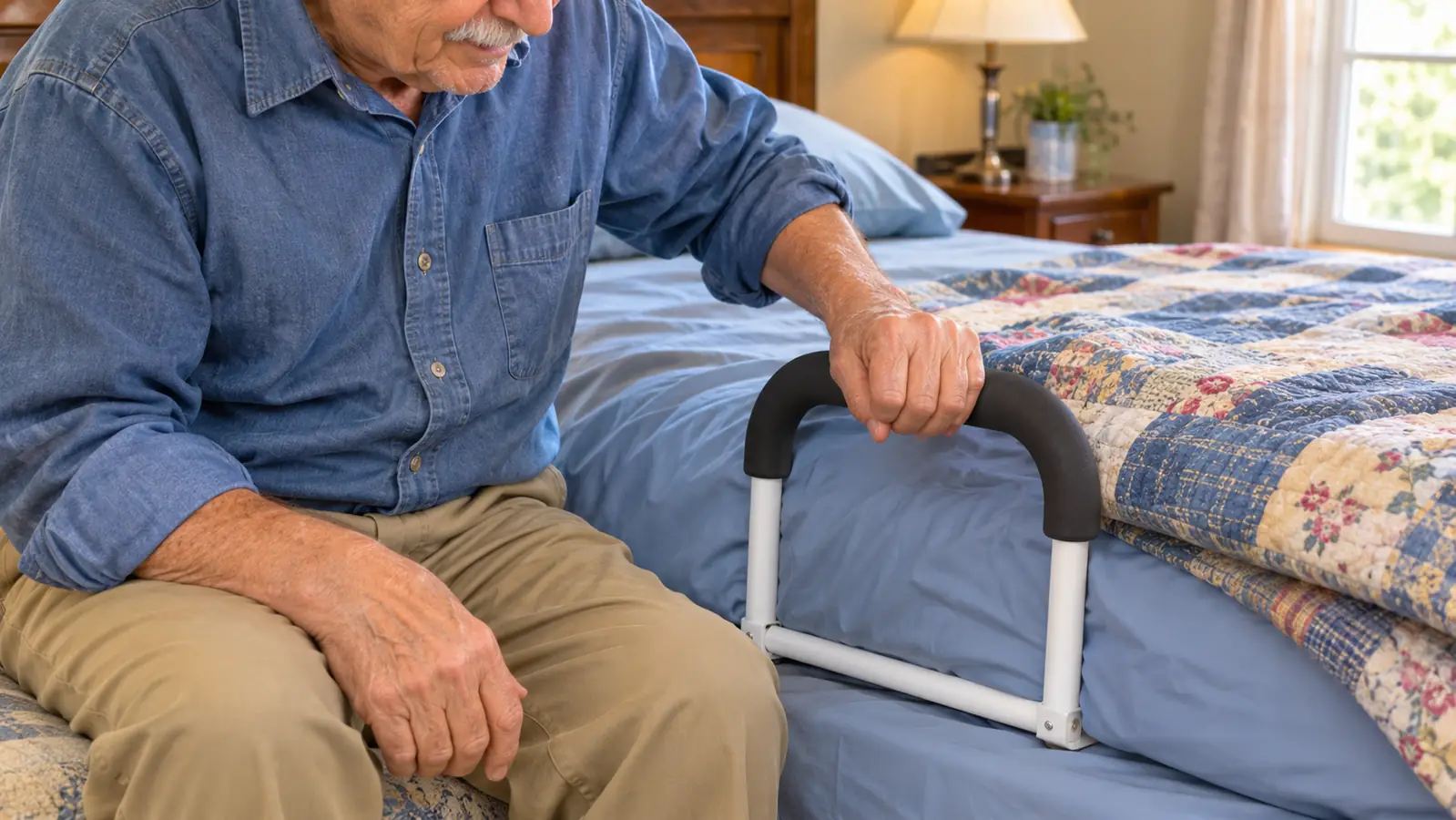
Mine is on the right side of a queen bed, the side nearest the bedroom door. Wade slid the frame under the mattress, ran the safety strap around to hold it, and set the hand bar at a height where my hand lands on it without me having to look. That last part matters more than I expected. In the dark, at two in the morning, I am not aiming. I am reaching. The bar has to be exactly where my hand goes, and it is.
Here is my actual routine, ten months in. I wake up, I roll to my side, I put my right hand on the non-slip hand bar and push down while my legs come over the edge. Then I sit for a count of five before I stand. That count of five is not the rail's doing, that came from my physical therapist, but the rail is what makes the sitting-up part steady enough that the count of five is even possible. Before, getting my legs over the edge was the whole event. Now it is just the first thing I do.
I also use it for the night trips, and that is the reason I keep it. Every morning use is routine. The night use is the one that matters. My balance is worse when I am tired, worse in the dark, and worst of both at two in the morning. Having a fixed point to hold while I get my feet under me has changed how I feel about getting up at all. I do not lie there arguing with myself about whether I really need to go. That arguing was costing me sleep.
What It Actually Is, and What It Isn't
Let me be clear about the category, because I have seen people get confused. This is a bed assist rail. It is not a hospital bed rail with bars on both sides, and it is not a grab bar bolted to a wall. The Medical king rail is a metal frame that slides under the mattress with a strap for security and a padded hand bar you reach for. It weighs about 6 pounds, and the height adjusts, and it assembles without tools.
The listing says it meets all the USA safety requirements, which I noted, though what actually convinced me was Wade pushing down on the bar with his full weight before he would let me near it. It also says outright that it is for seniors and not designed for kids, and I appreciate a company that names what a thing is for instead of pretending it is for everybody.
That is the whole of it, and I mean that as praise. There is nothing on it to figure out. No settings to relearn when I am half awake. I wipe it with a damp cloth when it gets dusty, which is what the care instructions say, and that is the entire maintenance schedule for ten months of ownership.
What it is not is a walking aid. It holds still and you push against it. It does not go anywhere with you. If you need help crossing a room, that is a cane or a walker, and I use both of those for their own jobs. This rail's job begins and ends at the edge of the mattress, and I would rather have a tool that is honest about its one job than a gadget that pretends to do five.
Why the Strap and the Hand Bar Are the Two Details That Matter
When I was younger I would have looked at a bed rail and thought, well, it is a bar, how complicated can it be. Now I look at the two things that decide whether one of these is safe or a nuisance.
The first is the strap. A rail that only slides under the mattress will shift over time, because mattresses compress and people roll around. The strap holds it where it belongs. Ten months of me pushing down on that bar with most of my upper body weight every morning, and it has not walked out from under the mattress or tipped toward me. That is not luck. That is the strap doing its work.
The second is the non-slip surface on the hand bar. My hands are stiff in the mornings, and my grip is not what it was when I was slinging mail into boxes. A bare metal bar would have me worried about my hand sliding when I put weight on it, especially in the dark when my palm might be a little damp or a little cold. The padding and the texture mean my hand stays put even when I am not gripping hard.
The morning use is routine. The night use is the one that matters. My balance is worse when I am tired, worse in the dark, and worst of both at two in the morning.
One more thing I noticed and did not expect: the rail gives you a place to rest your hand while you sit. I sit on the edge of the bed for those five seconds before standing, and having my palm on the bar during that pause is calming in a way I cannot fully explain. It is the difference between sitting on a dock and sitting on a dock with a railing.
The Setup, and the One Thing I'd Do Differently
Wade had it on the bed in about ten minutes. No tools. He slid the frame under the mattress, ran the strap, adjusted the height, and had me sit on the edge and reach for the bar to check it. That is the part I would tell anybody to slow down for. Do not set the height standing up. Set it sitting down, in the position you will actually be in when you use it.
The thing I would do differently is a small one, and it is not about the rail. I would have put a small lamp within reach on the nightstand the same week. The rail solved the steadying problem. It did not solve the seeing problem. Those are two different problems and I spent a couple of months treating them as one.
The other honest note is about the mattress. Mine is a queen, and the frame sits where the mattress meets the edge. If your mattress is very thick or very soft, ask about fit before you order. My neighbor at church has a deep pillow-top and he found his sat a little high for him. That is not the rail's fault, it is a fit question, and it is worth a phone call to your physical therapist rather than a guess.

Ten Months In: What Held Up
I am hard on things without meaning to be. I lean on them. I catch myself on them. I do not think about them being equipment.
Ten months of daily use and the Medical king rail is exactly as solid as the day Wade put it on. No wobble in the frame where it slides under the mattress. No give in the bar. No rust, no rattle, no screw working loose. The padded hand bar has not split or flattened where my hand goes, which is more than I can say for a pair of gloves I bought in the same season.
And it has quietly changed my mornings. I do not plan around getting out of bed anymore. For the first year after my hip replacement I would think about it before I did it. Now I just do it. That is a small sentence to write and a large change to live.
Tradeoffs I'll Name Plainly
It is one-sided. That is not a flaw, it is what the product is, but if you roll toward the other edge of the bed at night, the Medical king rail is not over there. I sleep on my side nearest the door, so this worked out for me. If you switch sides, think about that before you order.
It is not a bed rail system for someone who needs to be kept in bed. That is a different device with a different purpose, and it should be a conversation with a clinician, not a purchase. This rail is for a person who can get up and wants to get up more safely. That is who I am and that is who it serves.
And it does not travel. Mine stays on the bed. If you are going to your daughter's for two weeks, you would be taking it off and putting it back on, and while the assembly is genuinely tool-free, that is still a thing to think through before you commit. The weight is about 6 pounds, so carrying it is not the issue. Refitting it is the small annoyance.
What I Liked
- Gives a fixed, solid point to push against when swinging your legs out of bed
- The strap holds it in place, so it does not shift or tip under daily weight
- Non-slip padded hand bar helps when your grip is not what it used to be
- Adjustable height, set it while you are sitting on the edge of the bed
- Assembles without tools, mine was on the bed in about ten minutes
- About 6 pounds, wipes clean with a damp cloth
- Ten months of daily use with no wobble, rattle or wear
Where It Falls Short
- One-sided, so it only helps on the side of the bed where it is mounted
- Does not travel easily, refitting it for a trip is a chore
- Fit depends on your mattress, very thick or very soft mattresses may sit differently
- It steadies you getting out of bed and does nothing else, no help crossing the room
Who This Is For
It is for the person who can get out of bed under their own power but does not trust the first five seconds of it. That is the exact description of me. If you have had a hip or knee replaced, if your balance has gotten unreliable, if you are tired in the evening and worse in the dark, this belongs on your side of the bed.
It is also for the spouse or the adult child doing the worrying. Doris is the one who notices when I am getting tired before I notice it myself. The rail is the kind of thing that lets her stop listening for a thump in the night. That is worth something separate from what it does for me.
And it is for someone who wants a tool with one clear job. If you already have a cane for the short trips and a rollator for the long ones, this is the third piece, the one that handles the ten seconds between lying down and standing up.
Who Should Skip It
Skip it if what you actually need is a walking aid. If your problem is crossing the bedroom or the hallway, a rail on the bed will not help you and you will be disappointed in it for an unfair reason. Talk to your physical therapist about a cane or a rollator instead.
Skip it if the person in question needs to be kept from getting out of bed without help. That is a clinical decision and a different piece of equipment. Ask your doctor. Do not buy a bed assist rail for that job, because it is not built for it and it is not advertised as such.
And skip it if you are not willing to set the height sitting down. A rail set two inches wrong is a rail you will not reach for, and then you have spent the money and gotten none of the benefit. Ten minutes, sitting on the edge of the bed, reaching for the bar. That is the whole installation.
Ten months later, my hand still lands on it without looking
Adjustable height, non-slip hand bar, safety strap, about 6 pounds, no tools required. Set the height while you are sitting on the edge of the bed and let it do its one job. Ask your doctor or physical therapist about fit and use first.
Amazon Check Today's Price on Amazon →One last word, and I mean it as a neighbor and not as a salesman. Whatever you buy, talk to your doctor or your physical therapist about it first. They know your body and I do not. What I know is that a wobbly first step in the dark scared me enough to do something about it, and that ten months of reaching for a solid bar every morning has made me stop thinking about the edge of the bed at all. That is all I wanted. Ask about fit, set the height sitting down, and keep a lamp within reach.