

I got up in the dark one night last winter, swung my legs off the side of the bed the way I have done for fifty years, and the first step did not hold. I caught the nightstand with my left hand and stood there a minute with my heart going and my bare feet cold on the floor. No fall. I want to be plain about that, because I have never fallen, not before the hip replacement and not since. But you do not need a fall to learn something. The next morning I told Wade, and by that afternoon there was a Medical king bed rail slid under the mattress on my side of the bed. That was about ten months ago and I have used it every morning since.
So here is the short answer, and then I will show my work. A bed rail and a rope bed ladder are not two versions of the same thing. They help opposite halves of the same problem. The rail is for sitting to standing. You are already on the edge of the bed with your feet on the floor, and you need something beside you to push down on while your legs catch up. The rope bed ladder is for lying to sitting. You are flat on your back, and you pull yourself up hand over hand on the rungs until you are upright. If your trouble is the last six inches, you want the rail. If your trouble is the first two feet, a ladder has an honest argument. Most everybody I know, myself included, has more trouble with the last six inches.
| Medical king Bed Rail | Rope Bed Ladder | |
|---|---|---|
| How it mounts | Slides under the mattress with a strap for security, fits all beds | Hooks or ties over a footboard or a frame rail, so the bed needs something at the foot to hang from |
| Height adjustment | Adjustable heights, tool free, no tools required | The spacing between the rungs is fixed once it is tied |
| Lying flat to sitting up | You push down, and the bar is beside the pillow end, not above you | You take a rung and pull, hand over hand, until you are up |
| Sitting to standing | A non-slip hand bar lands right where your palm already lands | The rungs sit at the foot of the bed, behind your shoulder, not beside your hip |
| Load on shoulders and wrists | You push down through the heel of your hand; your legs answer | You pull, so the work goes up through your shoulders |
| Floor space beside the bed | Nothing on the floor; the feet still land where they always land | The tail of the rope hangs into the space your feet drop into |
| Packing it to travel | About 6 pounds and it slides under a mattress, but it is meant to stay put once strapped | Rolls up small and drops in a bag |
| Listing and safety wording | Meets all USA safety requirements, listed for seniors, not designed for kids | No listing standard of that kind; you are trusting the rope and the knot |
| Best for | Someone who sits up fine but needs something steady for the stand | Someone who cannot get from flat on their back to sitting without a pull |
Where the Medical king Bed Rail Wins
The rail wins on one thing that matters more than the rest of this article: it is beside you. The hand bar sits at the mattress edge where your hand already lands when you sit up, and it is non-slip, so a dry palm in February does not slide off it. When I lean forward and push, the weight goes down through my hand and my arm, and my legs get the message. That is the whole trick of standing up after a hip replacement. My physical therapist put it in different words, but it came to the same thing. Push, do not pull.
It also mounts where I need it. The rail slides under the mattress and a strap anchors it so it does not walk off in the night, and the listing says it fits all beds, which matters in a house with a queen in one room and a double in the spare. The man at church with the rope ladder has a footboard to hang his from. If your bed has no footboard and no rail at the foot, a ladder has nothing to hold onto. Mine is a plain queen frame with nothing at the end of it, and I sleep on the side nearest the door.
Small things that earned their keep. The height adjusts, tool free, no tools required, so Wade had it set in about ten minutes and I have nudged it since without hunting for a wrench. It weighs about six pounds, so I can lift the mattress corner and move it myself when Doris changes the sheets. It wipes with a damp cloth. And there is nothing on the floor. That sounds like a small thing until you are barefoot at two in the morning and your feet land exactly where they always land.
Changing the sheets turned out to be the real test, and I did not see it coming. Doris strips the bed every Saturday morning and I lift the corner of the mattress, slide the rail out, and lean it against the wall while she works. Ten months of Saturdays and the strap has not frayed and the frame has not bent or loosened. The spare room has a double bed with a thinner mattress on it, and one afternoon out of curiosity I carried the rail in there and set it up. It sat level and the bar came up to about the same place against my hand. I took it back to my own room, but I like knowing it would work if Doris ever needed it.
One more, and then I will move on. The listing says the Medical king assist rail meets all USA safety requirements and that it is for seniors, not designed for kids. There are no little ones in this house anymore, but I liked seeing that sentence on the page. The rope ladder photos I looked at do not carry anything of the kind, and I would not want a grandchild treating one like playground equipment either.

Where a Rope Bed Ladder Wins
Now the other side, because a rope bed ladder has a real argument and I am not going to pretend otherwise. When I am flat on my back and my hip is stiff and the clock says ten minutes past two, the hardest part of the whole business is getting from lying to sitting. That is a pull, not a push. A rope ladder is built for exactly that pull. You take a rung, pull, take the next one, and you are up. The rail does not do that job. It is beside you, not above you, and you cannot pull on it from flat on your back.
I got my hands on one, briefly, which is more than most people writing about these things can say. The man from church brought his out to the truck after Wednesday coffee and let me pull on it while it hung off his open tailgate, with him standing right there watching me like I was a new radiator cap. The rungs are rigid and the rope is thicker than the pictures make it look, and it did not give an inch. But I noticed what my shoulders did. Two pulls and I felt it across the top of my back, and I am not a small man. A younger body would not think twice about it. Mine thought about it for two days.
Second, the ladder travels. It rolls up and goes in a bag, which is why the fellow at church takes his to his daughter's place in Alabama twice a year. My rail is about six pounds and it slides under a mattress, so it moves from room to room fine, but I would not pack it in a suitcase and I would not want to re-strap it in a strange bed in the dark.
And third, it is simple. Rope, rungs, a hook. Nothing to adjust and nothing much to go wrong. I will say the honest thing though. I have watched that man get up with his ladder, and he works for it. Pulling with your arms when your shoulders are seventy-four years old is a different kind of tired than pushing down on a bar. My shoulders are not what they were in my mail-carrying days. Push works better for me, and my doctor agreed when I asked about the difference.
A rope ladder asks your shoulders to do the work of standing up. The rail asks your legs. At seventy-four, I know which one I would rather ask.
You push down, your legs answer: see today's price on the Medical king rail
Slides under the mattress, strap for security, non-slip hand bar, adjustable height, tool free assembly, about 6 pounds. Rated 4.4 from 9,618 reviews.
Amazon Check Today's Price on Amazon →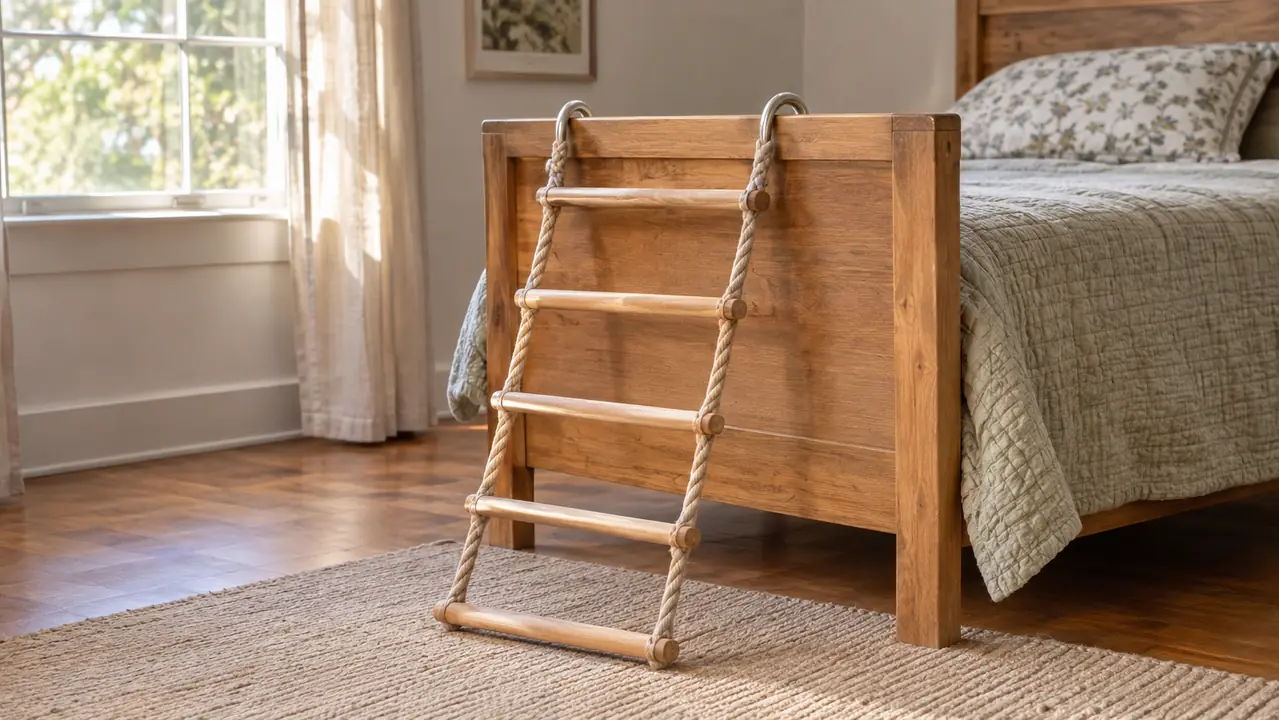
The Morning That Settled It
I want to describe the morning properly, because the decision was made in about four seconds and the rest of this is me talking myself into what I already knew. It was January, cold for Mississippi, and Doris was still asleep. I swung my legs out, put my right foot down, and it went out from under me. Not far. Just enough. My hand found the nightstand and I stood there in the dark holding a lamp I had nearly knocked over, and the thought in my head was not about falling. It was about how I would get back up if I did.
Here is how little it took to set that off. The top of my mattress sits twenty-four inches off the floor, which I know because I measured it with a tape the following week. My feet land flat when I sit on the edge. That night my right foot came down on the corner of a throw rug beside the bed and the rug slid. The rug is gone now, but the rug was not the real problem. The problem was that my hand had nothing to find except a lamp and a nightstand with a clock and a glass of water on it. I knocked the water over. That was the whole emergency, a wet clock and a scared man in his undershorts at two in the morning.
Wade came by that afternoon. He slid the rail under the mattress on my side, ran the strap, set the height, and was done before the coffee went cold. The first week I used it like a man testing a new rung on a ladder, hand on the bar, weight mostly on my own legs. By the second week I was leaning on it without thinking about it, and that is the point of the thing. You do not want to be thinking about your equipment at two in the morning. You want to be standing up and walking to the bathroom.
Ten months on, I use it every morning and on every night trip. There is a spot on the hand bar where my palm goes, and I could find it in the dark, and I do, most nights. Doris says I get up easier. I do not know about easier. I know I get up without that half second of deciding.
The thing I would tell any man my age is this. The rail did not make me steadier. It gave me something steady to hold. There is a difference, and the difference is that one of those is me getting better and the other one is me being careful. I will take careful. Careful is what got me back to the coffee table at the feed store on Wednesday mornings and back in my own pew on Sunday.
Who Should Buy Which
If you sit up fine and the stand is the hard part, the last six inches from the mattress to your feet, buy the rail. That is my situation and the Medical king rail is what is on my bed. If your bed has no footboard, that is another reason, because a rope ladder needs something to hang from and a plain frame gives it nothing. And if your hands are stiff in the mornings like mine, a fixed bar you push down on is friendlier than a rope you have to grip and haul.
If you are flat on your back and cannot get to sitting at all, that pull is precisely what a rope ladder does, and I would look at one seriously. Better still, ask your physical therapist which one matches what your body is actually doing. That is not a throwaway line at the end of an article. A therapist watches you get out of a chair and knows in thirty seconds which half of the movement is failing. Mine did, twice, and both times he was right.
One practical thing before you buy either one. Measure the height of your mattress top from the floor with a tape, and measure it on the side you actually sleep on, because a pillow top or a thick pad changes the number by a couple of inches. Then sit on the edge with your feet flat and notice where your hand naturally lands. That spot is where the bar needs to be, and the rail adjusts to meet it at whatever height you set. A ladder cannot be adjusted to your hand. It hangs where the foot of the bed puts it, and you take what you get.
Either way, set the thing up and test it in daylight before you trust it in the dark. Check the fit, check that it does not move when you lean on it, and check the strap again after a week of real use. A bed aid is only worth what it does at two in the morning when you are half awake and not being careful.
The one that was still on my bed ten months later
Slides under the mattress, strap for security, non-slip hand bar, adjustable height, tool free, about 6 pounds. Ask your doctor or physical therapist about fit and use before you rely on any bed aid.
Amazon Check Today's Price on Amazon →