

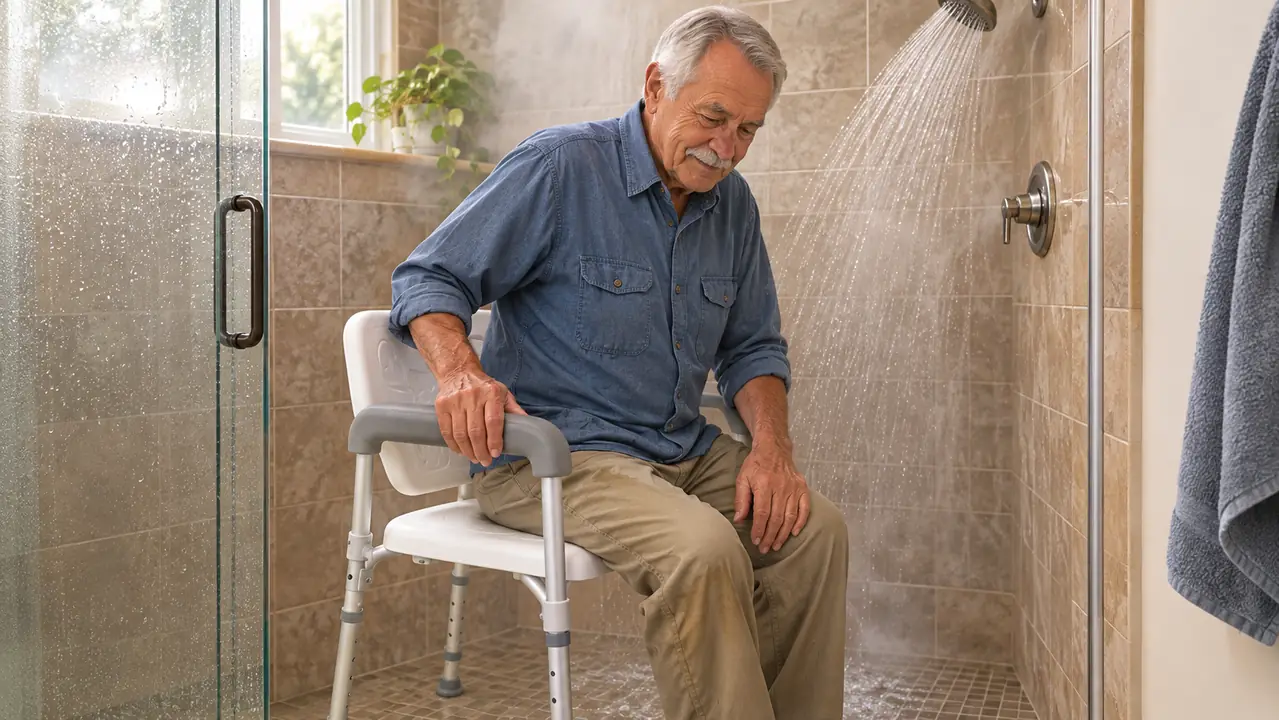
I bought this chair two weeks before my hip replacement, on my physical therapist's advice, and I sat on it in the shower this morning the same as I have every morning for the last eighteen months. That is most of the review right there. I am 74, I live in a one-story brick ranch outside Tupelo, Mississippi, and until the spring before last I showered standing up like anybody else. Then my right hip quit on me, and standing in a wet stall with soap in my eyes stopped being a sensible thing to do. I did not want a chair in my shower. I wanted my shower back the way it was. What I got instead was a piece of equipment that has quietly earned its place in that stall every single morning since.
The Medline Premium Shower Chair with the back and the padded armrests is what ended up in my stall, and it stayed. Aluminum frame, 7.1 pounds, six height positions, rolled padded arms, a contoured back. Coming up on a year and a half of daily use, it has not wobbled, chipped or rusted. Here is what it does well, what it does not do, and who ought to walk right past it.
The Quick Verdict
Eighteen months of daily showers and it still sits solid on a wet floor. The padded arms and the contoured back are what earn it, and they are the reason I would buy it again tomorrow.
Amazon Check Today's Price →The chair I sit on every morning, eighteen months after the surgery that put it there
Lightweight aluminum, a contoured back, rolled padded armrests and six height positions. Of everything I bought for my recovery, this is the piece that never went out to the shed.
Amazon Check Today's Price on Amazon →How I've Used It
My physical therapist brought it up before I did. She asked how the bathroom was laid out and I told her the truth: a walk-in stall with a low lip, no tub, a floor that goes slick as a fish the second the water runs. She said get a chair with a back and arms before the surgery, not after, and get it set up early so you are already used to it when you come home sore. That was the end of the discussion.
Wade ordered it. He is my son, he lives about thirty minutes away in Saltillo, and he carried the box in from the carport with one hand, which tells you what 7.1 pounds feels like still in the packaging. He set the height. There are six positions on the legs and he worked at it until my feet sat flat on the shower floor and my knees came up level with my hips. That is the whole trick with a shower chair as near as I can tell. Too low and you cannot get yourself up out of it. Too high and your feet dangle and you feel like you are perched on a fence post.
The first shower I took at home after surgery, Wade was in the hallway and Doris was in the kitchen pretending to read the paper. I sat down on that chair, and I washed, and I stood back up using both padded arms, and nothing hurt the way I had braced for it to hurt. I have taken somewhere north of a thousand showers since. I have not once worried about falling in there.
For the first six weeks I followed my surgeon's hip precautions. No bending past a right angle, no crossing my legs. There is no version of that where I wash my own feet and legs standing up. Sitting on the Medline chair with two arms to push off of, it was not even a question. Sit down, wash, stand up. Nothing about the routine asks you to bend, and that is the reason this chair never went out to the shed with the rest of the recovery gear.
The Six Height Positions, and Why They Matter More Than They Sound
Six sounds like a number somebody in a marketing office made up. It is not. Wade set mine for my legs, and there is a position two notches below mine that would suit Doris at 72 if she ever had a mind to use it. One chair can be a tall man's chair or a short woman's chair. Changing it takes a few minutes, and it is a two-hand job, easier with somebody holding the frame steady while you work the leg section free and set it back down.
The frame is aluminum, which is where the 7.1 pounds comes from. In a shower that stays damp most of the day, that matters more than it sounds. I have rusted out a steel folding chair in the yard from less. Eighteen months on, the legs look like they did the week I unwrapped them. The feet are slip-resistant rubber, four of them, and they still grip the shower floor when the water is running and the whole stall is wet. That grip is the part I would not want to lose.
Listed seat height is 21 inches. The seat runs 16.3 inches wide and 13.4 inches deep, and the chair stands 33.7 inches tall at the back. I did not measure any of that with a tape. I am giving you the numbers because you will be standing in your own bathroom holding one, wondering whether it fits between the walls. In my stall it does, with room on both sides. In a narrow stall you would want to check before you order.
It is rated to 350 pounds. I am nowhere near that and I never think about it. If you are a heavier man, the number is printed there and it is worth knowing before you buy.
Padded Arms and a Contoured Back, Which Is the Whole Point
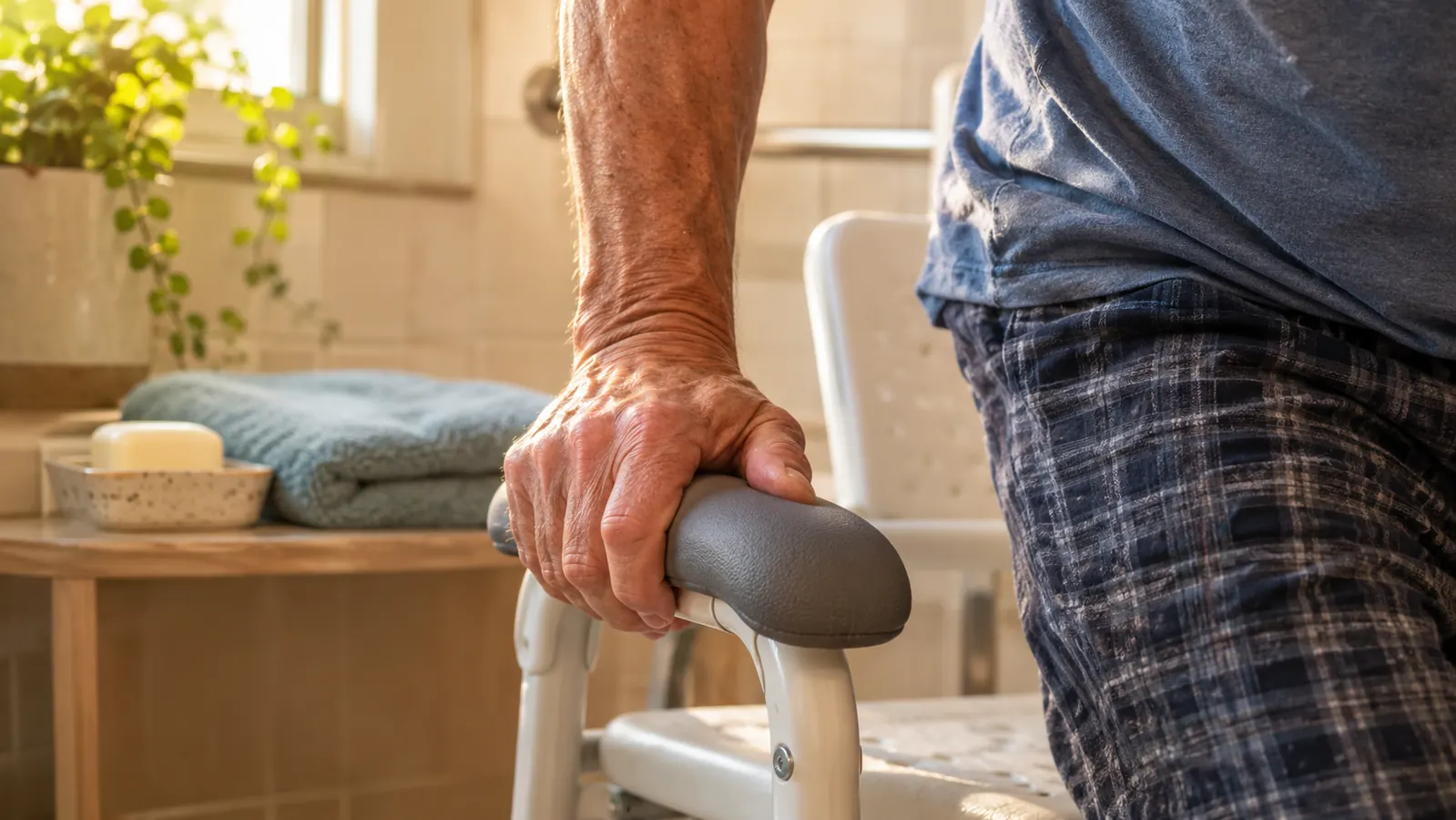
You can buy a plain shower stool with no arms for less. I looked at them. What changed my mind was my hands. They are stiff in the mornings and have been worse since the surgery, and there is a real difference between laying a flat palm on a padded armrest and trying to close a stiff hand around a bare rail. The arms here are rolled, and they are padded, and that padding is doing honest work at seven in the morning when you are half awake and the floor is wet.
The back is contoured, not a flat board. It curves to fit the shape of a person, so when you lean back to rinse your hair you have something to lean against rather than a straight edge in your shoulder blades. I lean back, let the water run, and take my time. At 74 with a hip that came out and went back in, a hot shower you can take your time in is not a small thing.
The arms are also where I push off from. Both palms down, lean forward, stand. That is the same motion I use getting out of a pew at church, so my body already knew it. Without arms you would be pushing off your thighs, and pushing off a thigh with a fresh hip in it is exactly what you are told not to do.
It came with a step-by-step manual and Wade used it. Nothing about the setup is complicated, but on the week you are getting ready for surgery, complicated is the last thing you need in your life. He had it standing in the stall before supper.
Eighteen Months of Daily Showers: What Held Up
Twice a day most days, since two weeks before the surgery. Nothing has loosened. Nothing has cracked. The rubber feet are still soft enough to grip, the padding has not split, and the frame has not rusted. I own a bed rail, a rollator and a reacher grabber, and I have a hard time naming another piece of recovery equipment in this house that has held up this well for this long.
Maintenance is close to nothing. Doris wipes it down once a week with the same spray she uses on the shower walls. Every few months I pull the leg sections apart and rinse the soap scum and hair out of the adjustment joints, and that takes ten minutes with the chair sitting on a towel on the bathroom floor.
It carries a one-year limited warranty from Medline. I am well past that and have never had a reason to use it. What I can tell you is that it does not feel like a one-year item. It feels like the sort of thing you buy once and then hand down to somebody who is about to have the same surgery you had.
What it will not do is make you faster or braver. It is a chair. It does not bolt to the wall and it is not a grab bar, so if you truly lose your balance on the way up, the chair is not going to catch you the way a bar would. It gives you a steady place to sit and two padded arms to push against. That is the whole of what it promises, and it has kept that promise every morning.
Where It Falls Short
Floor space. The seat is 16.3 by 13.4 inches and the chair is not something you can shrink, so in a small stall it eats the room you would otherwise use to turn around. If two people share one bathroom, somebody is moving it in and out every day. At 7.1 pounds it is easy to carry, but it is still a thing to carry. My stall is mine, so this has not cost me anything. In a busier bathroom it would.
You still have to be able to sit down and stand up. There is no motor and nothing mechanical that lifts you. The chair makes the work steadier and a good deal easier, and for about the first two weeks after surgery I wanted somebody within shouting distance anyway. If your legs are weaker than mine were, that is a conversation for your physical therapist and your doctor, not something to sort out alone in a wet shower.
And it is not a transfer bench. If your bathroom has a tub with a high side and the plan is to slide across into it, this chair does not do that job. Mine sits inside a walk-in stall. That is what it was built for.
One more. The height is set at the leg sections and it stays where you set it. If you and your wife are sharing this chair and she needs it lower than you do, you will be changing it back and forth, and it is a two-hand job with the frame tipped over. Not a deal breaker. Just know it going in.
What I Liked
- Seven pounds of aluminum that has not rusted through eighteen months of daily wet use
- Rolled padded armrests give you something solid to push off when you stand
- The contoured back lets you lean back and rinse without a board in your spine
- Six height positions cover a tall man and a short woman in the same house
- Slip-resistant rubber feet still grip when the whole stall is wet
Where It Falls Short
- Takes up real floor space in a small stall
- It is a chair, not a lift. You still supply the leg strength to stand
- Not a transfer bench, so it will not help you over a tub side
Somewhere north of a thousand showers, and the feet still grip and the frame still has not rusted. That is the whole case for it.
Who This Is For
If you are scheduled for a hip or a knee and your bathroom has a walk-in shower, buy this before the surgery, not after, and set it up early so you have a week of normal practice in it. If you are older and standing in the shower has started to feel like a gamble, this is a sensible thing to own. If your hands are stiff, or your knees are bad, or you have a spouse who needs a lower setting than you do, the padded arms and the six positions are worth the difference over a bare plastic stool. And if you are the son or daughter setting it up for a parent, the manual and the 7.1 pounds make it a twenty-minute job you can do before supper.
Who Should Skip It
If your only shower is over a tub, this is the wrong piece of equipment and a transfer bench is what you are after. If you need help getting up and down, arms on a chair will not do what a lift or a second person does, and that is a question for your doctor and your physical therapist. And if your stall is genuinely tight, measure that 16.3 by 13.4 inch footprint first, because once it is in there it is not going anywhere in a hurry.
Eighteen months in, it is still the first thing I reach for in the morning
Aluminum frame at 7.1 pounds, contoured back, rolled padded armrests, six height positions, 350 lb listing capacity. Ask your physical therapist where the height should sit before you set it.
Amazon Check Today's Price on Amazon →