

My bathroom is not a big room. It is the hall bath in a one-story brick ranch outside Tupelo, and the free floor space in it is about the size of the bed of my pickup. Two weeks before my hip replacement, my physical therapist told me I needed to stop showering standing up. So I did what I usually do with a problem. I got on the computer and read everything I could find about the two kinds of equipment that come up first, a shower chair like the Medline Premium Shower Chair with the back and the padded arms, and a tub transfer bench. Then I stood in the bathroom door with a tape measure and worked out which one this house would actually hold.
Here is the short answer. If your bathroom has a walk-in shower stall, even one with a low lip on it, the Medline chair is what fits and what you will still be using a year from now. A tub transfer bench solves a different problem. It is built to get a person over a bathtub wall, and to do that it needs the full length of the tub plus floor space beside it. In my bathroom that bench would have left me about a foot of room to walk in. The chair is in the shower right now. The bench never came home.
| Medline Shower Chair | Tub Transfer Bench | |
|---|---|---|
| Footprint in a small bathroom | 13.4 inches deep by 16.3 inches wide, sits inside the stall and nothing else | The length of the tub plus the floor in front of it |
| Stepping over a tub wall | Not built for it, the chair sits in a stall | Built for exactly this, you sit outside and slide across |
| Getting into a walk-in shower stall | Step over the low lip and sit down | No job here, there is no tub to bridge |
| Lifting your legs in | You step in, then sit | You sit first, then lift one leg at a time across the wall |
| Seat height | Six positions, listed seat height 21 inches | Set to match the tub wall, varies by maker |
| Arms to push up on | Padded rolled armrests on both sides | Often none, sometimes a single bar |
| Moving it out of the way | 7.1 pounds of aluminum, lifts out with one hand | Long frame, heavier, usually a two-hand job |
| Sharing the bathroom with somebody who bathes normally | Comes out of the stall in one hand | Comes out of the tub, or nobody takes a bath |
| Assembly | Ships with a step-by-step manual | Varies by maker, some arrive in pieces |
| Best for | A walk-in stall and a person who can step over the lip | A tub and a person who cannot |
How My Bathroom Made the Decision
The room is laid out the way a lot of ranch houses out here are laid out. Vanity and toilet on one wall, a walk-in shower stall on the other, with a lip at the bottom you step over. No tub. I know plenty of people in town with a tub and a shower curtain, and their answer may not be mine. But if you are choosing between these two pieces of equipment, the first question is not which one is better made. It is which one your bathroom has room for, and whether you have to climb a wall to get clean.
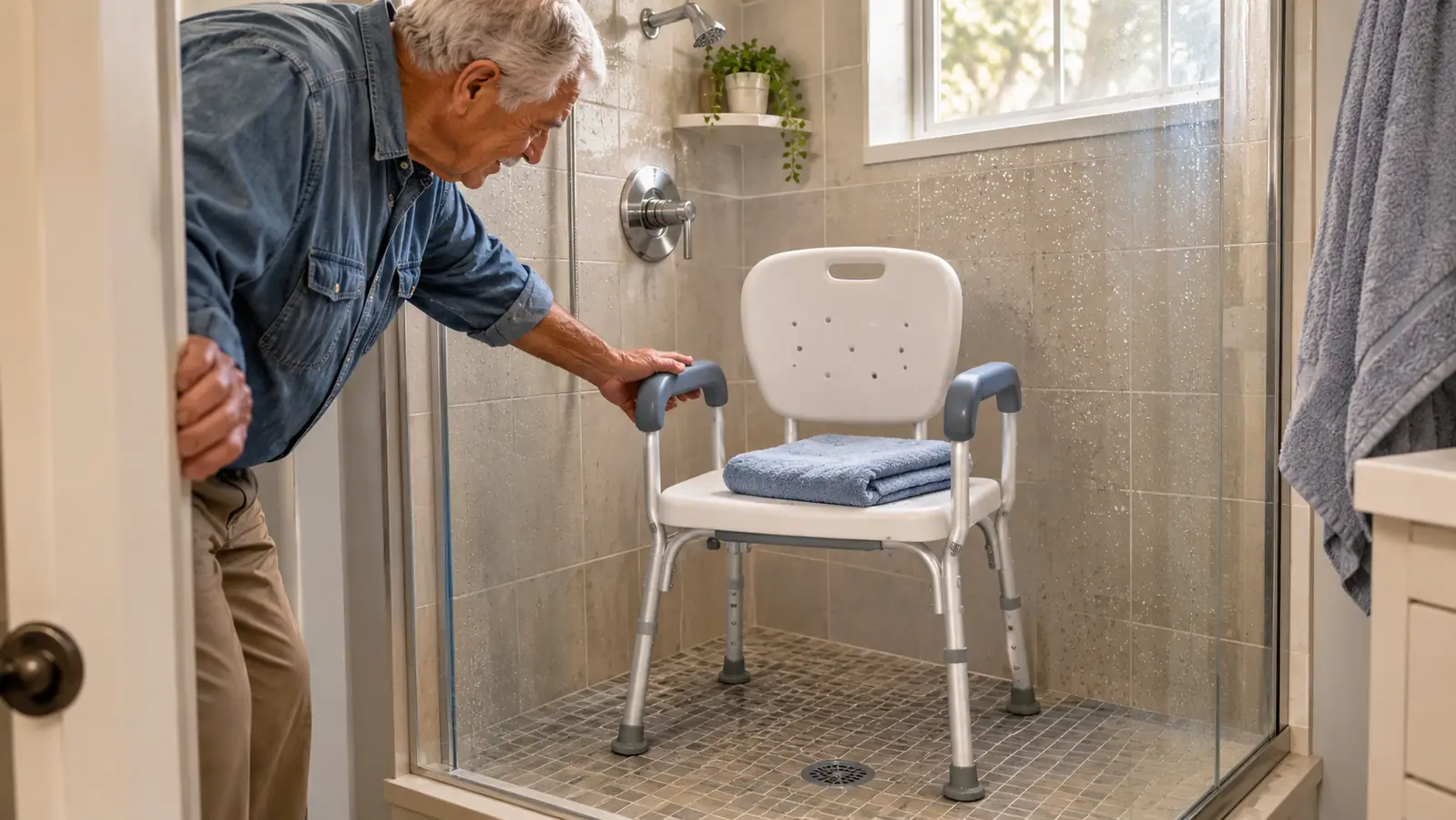
I measured the stall before I ordered anything. The Medline chair is 13.4 inches deep, 16.3 inches wide, and 33.7 inches tall at the back, which is a footprint that sits inside the stall and leaves the rest of the room alone. Mine went in two weeks before the surgery on my therapist's advice, and Wade set the height when he came over to check on me. I have not moved it since. It is 7.1 pounds of aluminum, so if I want it out of the way I pick it up with one hand, and that matters more than it sounds like it matters.
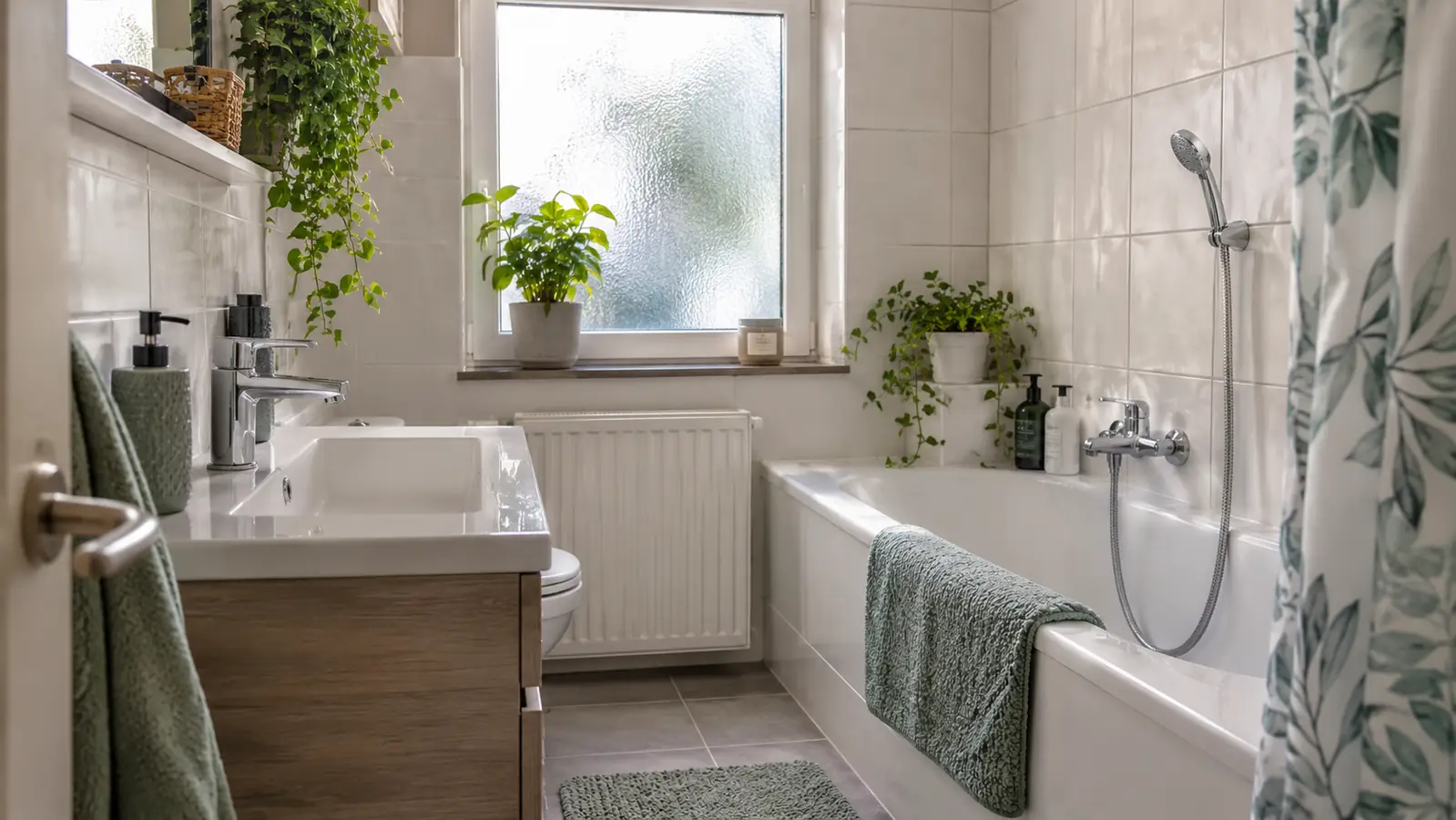
A tub transfer bench is a different shape of thing. It is a long seat, and the whole idea is that one end sits on legs outside the tub and the other end sits on legs inside it. You sit down on the outside, lift your legs over the wall one at a time, and slide across. It is a smart design. It is also the length of a tub plus the width of the floor in front of it, and in a hall bathroom that is most of the room you have.
Where the Medline Chair Wins
Space, first. A shower chair takes up a shower stall's worth of floor and nothing else. You are not stepping around it to get to the sink, and nobody has to lift it out of the tub so somebody else can take a bath. In a small bathroom that is the whole argument in one sentence.
Then the arms. The Medline has padded rolled armrests on both sides and a contoured back. I did not think much about that until the first week home, when standing up from a seated position was the hardest thing I did all day. You put your hands on those arms and push, and you are up. A lot of transfer benches have no arms at all, and the ones that do usually give you a single bar to work with. With hands that are stiff in the morning, that is the difference between showering alone and calling for Doris.
Height is the third thing. Six positions, and the seat height is listed at 21 inches. My therapist wanted me sitting high enough that I was not folding up to get down onto the seat, and low enough that both feet sat flat. We found that spot on the second try. The feet are slip-resistant rubber and they stay where you put them on a wet shower floor, which I checked with a wet hand before I ever sat down on the thing.
Where a Tub Transfer Bench Wins
It wins the one job it was invented for, and that is not a small thing. If you cannot step over a tub wall, a bench is how you get in. You sit on the outside end with your feet on the bathroom floor, you lift one leg at a time over the wall, and you slide across. Nobody lifts you, and you are never standing on one leg on a wet surface next to a hard tub rim. That is a real problem solved for a lot of people.
It also wins if the tub is your only way to bathe. I have stood in front of one at my physical therapist's office more than once, and a fellow at church has one in his tub. For a person whose only shower is over a tub, with a knee or a hip that will not let them climb in, the bench is the answer and a shower chair is not even in the conversation. No amount of padded armrests fixes a wall you cannot get over.
The other thing it does better is let you sit down before you lift a leg. During my first six weeks home I had hip precautions, no bending past a right angle and no crossing my legs, and I can see how sitting first and swinging the legs across would have suited that better than stepping in and turning around in a wet stall. If your surgeon has handed you that same list, a bench is worth a serious look.
I measured before I ordered. The bench would have taken the length of the tub plus the floor in front of it, and left me about a foot to walk in. The chair took the stall and nothing else.
If You Have a Shower Stall, This Is the One to Measure For
Aluminum frame, padded armrests on both sides, contoured back, six height positions, 350 pound listing capacity. Mine has been sitting in the stall for about eighteen months and I have not had to move it once.
Amazon Check Today's Price on Amazon →The Setup I Would Copy
Set the height with somebody watching you sit down and stand up. Not by yourself, and not by guessing from the picture on the box. Six positions is enough range that you can get it wrong in either direction, too low and you are folding up to reach it, too high and your feet are dangling.
Put it in the stall and leave it there. Everything you reach for in a shower, shampoo, soap, a washcloth, ought to sit at shoulder height so you are not bending or stretching up. Doris moved my things for me that first week and it made the whole business easier. Keep the floor of the stall clear.
Wipe the seat down and let it dry between showers, and check the rubber feet now and then to make sure they are still doing their job. That is the whole maintenance list. It comes with a step-by-step manual and a one-year limited warranty, and I have never had to use the warranty.
The Tradeoffs Nobody Lists
The seat is compact. 16.3 inches wide and 13.4 inches deep is enough for most people, and it was enough for me at 190 pounds, but a big man will notice it. If you are wide through the hips, sit in one before you buy, or have somebody check the seat dimensions against what you actually need. Nobody at the store will volunteer that.
It is also a chair that lives in your shower. If two people share that bathroom and only one of them needs the chair, somebody lifts it out and puts it back. At 7.1 pounds that is a small job, and it is a good deal smaller than moving a bench the length of a tub. But it is still a job, and I would not pretend otherwise.
One more thing. A chair in the shower does not solve the whole bathroom. If you are unsteady on the tile between the shower and the bedroom, or in the dark on the way there, that is a different problem and a different piece of equipment. Ask your therapist about that separately.
The Questions I Would Ask Before You Buy Either
First, walk into your bathroom and look. A stall with a lip, or a tub with a wall. That one fact decides most of this, and it decides it before you read a single review.
Second, ask your doctor or your physical therapist about fit and use before you buy either one. Mine told me to get the chair two weeks before surgery and she told me where to set the height. I would have set it wrong on my own, I am fairly sure of that. The same goes for a bench. How high it sits, whether you should be sliding across a wet surface at all, and how you get your legs over the wall are questions for somebody who has watched you walk, not for a product listing.
Third, think about who else uses that bathroom. Doris is healthy and active and she does not need a chair in the shower, but she also does not want a bench filling the tub she uses. Whatever you buy, somebody lifts it now and then. Seven pounds is one thing. The length of a tub is another.
Who Should Buy Which
Buy the Medline chair if you have a walk-in shower stall, even a low one, and you can step over that lip while holding on to something solid. Buy it if you want arms to push up on, a height that can be set six ways, and something you can lift out with one hand. That describes most of the people I know in their seventies with a bathroom like mine, and it describes me.
Take a hard look at a tub transfer bench if the only shower in your house is over a tub and you cannot climb that wall safely. That is the reason the thing exists, and in that house it is the right piece of equipment. If you have both a tub and a stall, put the chair in the stall and use the stall. It is the one you will use every day without thinking about it, and after a while that is the only test that matters.
Whichever way you go, have your physical therapist look at the setup before you use it the first time. Mine looked at mine and moved it two inches. Two inches does not sound like much until you are the one standing up in it.
Eighteen Months In, It Has Not Left the Shower
Contoured back, padded rolled armrests, six height positions, slip-resistant rubber feet, 350 pound listing capacity. If your bathroom has a stall instead of a tub, start here and measure once.
Amazon Check Today's Price on Amazon →