

My right hip was replaced in the spring, a year and a half ago now, and the thing that caught me off guard was not the surgery or the therapy that came after it. It was the first morning home, standing in the bathroom door with a walker in one hand and a towel in the other, looking at a wet tile floor I had crossed without a thought for fifty years. In a shower stall you get one hand for the wall, one hand for the soap, and nothing left over for balance. That arithmetic stops working the day you have a new hip and a list of precautions you are trying not to break.
My physical therapist told me to buy a shower chair two weeks before surgery, not after. That was the most useful sentence anybody said to me that whole month. I went with the Medline premium shower chair with the contoured back and the padded armrests, and my son Wade set the legs for me in the stall before I ever needed to sit on it. I am not going to tell you a chair fixes anything. I am going to tell you what I actually did with it, in what order, and what I would say to a man in my position if we were sitting at the feed store with our coffee going cold.
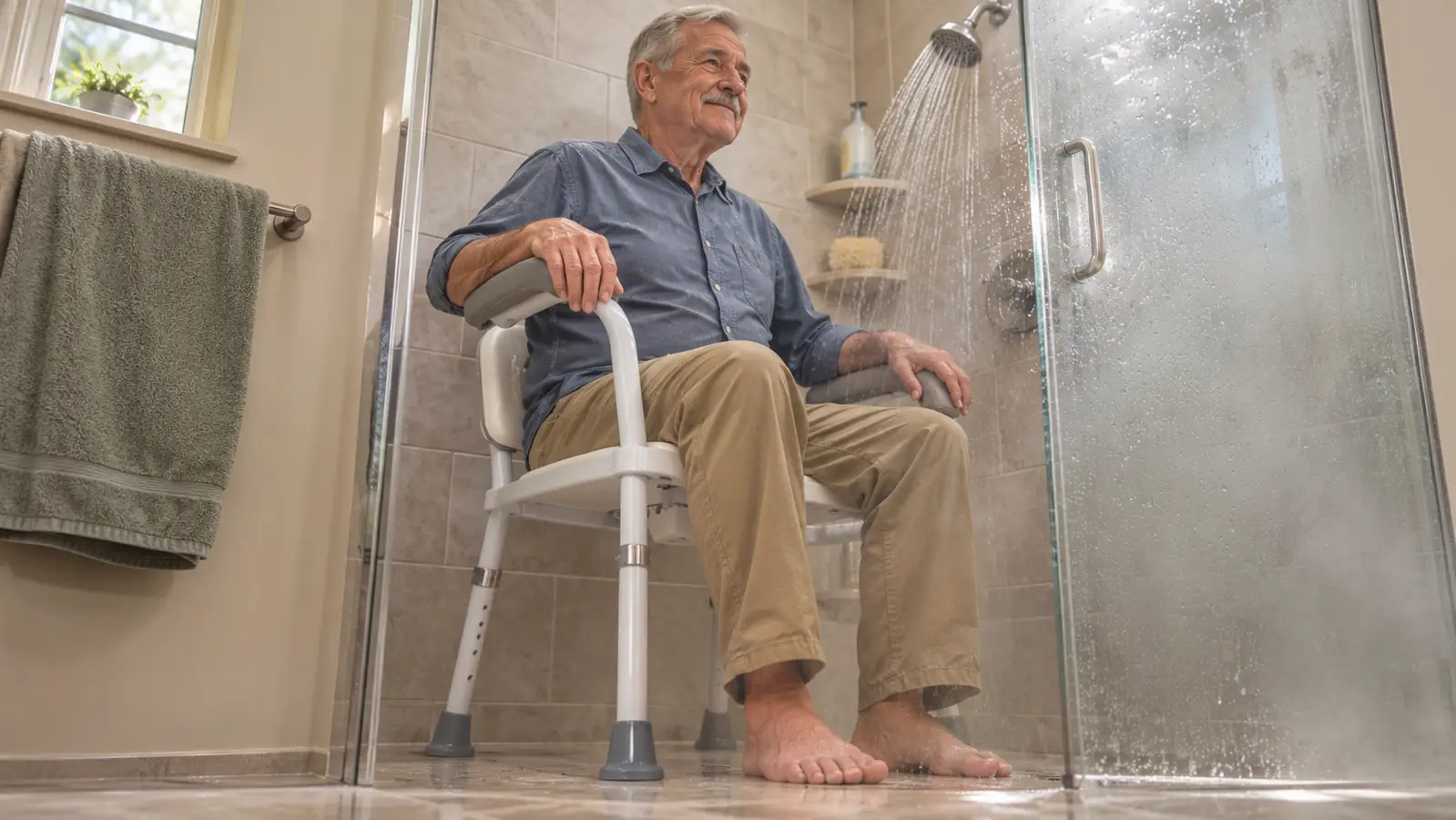
The chair that went into my shower two weeks before surgery, and is still there every morning
Aluminum frame, contoured back, padded rolled armrests, 6 height positions, 350 lb listing capacity. Wade had the legs set and the feet checked in about ten minutes with the manual that comes in the box. It weighs just over 7 pounds, so moving it to scrub the stall is nothing.
Amazon Check today's price on Amazon →Step 1: Get the chair in the shower before the surgery, not after
The box came in and Wade carried it to the bathroom on a Saturday morning, two weeks out, while I could still stand in that stall on my own hip and think straight about where things belonged. Doing that setup on the day you come home from the hospital is a bad plan. You will be tired, you will be on pain medicine, and somebody will be guessing at the height.
Here is the layout we settled on. The chair sits at the back of the stall with the backrest toward the wall, so I face the shower head and the handles. Everything I use goes at shoulder height or a little below, never at knee level: shampoo, soap, washcloth, all of it on a small shelf or in a hanging caddy. The towel goes on a hook by the door with a dry mat under it. Bathrooms are small rooms, and the reaching you do without thinking about it is exactly the reaching that gets a new hip into trouble.
Step 2: Set the height with help, then pull on every leg
Height matters more than I expected it to. The Medline chair has 6 height positions, and the seat can be set from a low stool height on up to something closer to a dining chair. My therapist gave me the rule in one sentence: when you sit down, your knees should be at or below your hips. Set it too low and you have to shove yourself up with your arms, which loads the front of the hip. Set it too high and you slide forward every time you shift your weight.
Wade set the legs, then did something I would not have thought of. He pulled hard on each leg to make sure every one was seated in its position, set the chair down on the tile, and pushed it side to side. It did not rock. The slip-resistant rubber feet hold the floor, and the straight legs sat evenly. That chair weighs a little over 7 pounds and slides easily when I want to clean behind it, but it does not wander an inch when I put my weight on it.
The step-by-step manual in the box walks you through the leg adjustment, and it took him maybe ten minutes start to finish. Even so, I would have your physical therapist look at the finished height before you trust it. Mine had me sit, stand, and sit again while she watched my knees, and she moved it up one position from where I had it. I would never have caught that on my own.
Step 3: Sit before you step, and step before you turn
The precautions I was given were not suggestions and they were not vague: no bending past a right angle, no crossing your legs. Both of those are easy to do by accident in a wet shower when you decide to reach down for your own foot.
My order of operations is the same every morning. Walk to the stall with the cane or the walker. Put one hand on the grab bar or the wall. Sit down on the chair first, then bring your legs in one at a time. Wash. Rinse. Turn the water off while you are still seated. Dry everything you can reach while you are still seated. Then bring one foot out and set it flat on the mat outside, push up on the armrests, and bring the other foot out behind you. Padded armrests sound like a small luxury until the first morning you genuinely need to push yourself up on them.
Two things I had to learn on my own. The slippery part is the floor outside the stall, not the shower. It takes the drips, it has no texture to it, and it is where your bare feet land. The other thing is that tired people rush, and rushing is where the order goes out the window. I shower in the mornings now, not at night, because mornings are when I have the most left in the tank. Your schedule may be the opposite. Pick the hour when you are freshest and keep it.
Two weeks before surgery I put a chair in my shower. Eighteen months and a lot of mornings later, it is still in there and I still sit on it, every single day.

Step 4: Wash in a fixed order so you never twist
Standing in a shower means you turn to reach your back, your feet, the soap you dropped. Seated, you do not have to turn at all, but only if everything you need is where your hands already are. That is the whole reason the shelf placement in Step 1 matters as much as the chair does.
I wash in the same order every time. Hair first, while I am freshest, then face, then arms and chest, then legs, then feet last while I am still sitting with one leg propped up on the other knee only as far as the precautions allow. A long-handled sponge with a plastic handle is worth owning for the back of the calves and between the toes. It is not a medical device, it is a handle with a sponge on the end, and it means I have not once bent past that right angle in eighteen months of daily showers.
For the soap that gets away from you, leave it. Finish your shower, get out, dry off, then deal with it. Reaching down for a bar of soap in a wet stall with one hand on a wet wall is the exact motion a replaced hip does not forgive. Rinsing is the same idea in reverse: let the water do the work, start at the shoulders, and let it run down. Do not twist to chase a spot on your back. You will get it tomorrow.
Step 5: Fix the rest of the bathroom, not just the chair
The chair was the biggest piece of the fix. It was not the whole fix. Wet tile does not care how good your balance used to be, and a bathroom you have used for decades has a dozen small hazards you stopped seeing years ago.
A grab bar bolted into the studs by the shower door is the next thing I would spend on, and that is a job for somebody with a drill and a stud finder. Not a suction cup from the hardware store, which will let go on you one day and give you no warning. A textured mat inside the stall and a second one outside it. A night light on the wall between the bed and the bathroom, because the trip at two in the morning is the trip where you are half asleep and the floor is dark. And a place to sit down while you dry off and dress, because standing on one leg to work a sock on is how people end up on the floor.
If your bathroom has a tub, that is a different job entirely, and the tool for it is a bench that spans the tub rather than a chair that sits inside it. Mine is a walk-in stall with a low lip, so a chair was the right answer for me and I am not going to pretend it is the right answer for your house. Look at what you actually have before you order anything.
What Else Helps
Two other things earned their keep through all of this, and neither one is a bathroom product. The first is a reacher. I bought a FitPlus PowerGrip T9 in the first weeks after surgery so I would not break the precautions by bending, and I still use it every day. In the bathroom it means I never stoop for a dropped towel, a sock, or a bottle that rolled under the sink. Mine lives beside my recliner, but the week it lived by the bathroom door was the week I stopped dropping things and saying unkind words about them.
The second is the cane I use around the house on tired evenings. My HONEYBULL folds and stands up on its own, and a cane that stands by itself turns out to matter when one hand is holding a towel and the other one is wet. The walk from the bathroom to the bedroom is short and it is still the walk where I want something in my hand. None of this replaces your doctor or your physical therapist. Mine gave me the height, the precautions, and the order of operations, and I would ask yours those same three questions before you take the word of a retired mail carrier on the internet, myself included.
How Long You Will Actually Need It
People hear shower chair and think of a hospital and a few weeks. I am here to tell you that the six weeks of precautions is not the same thing as the six weeks of needing a chair. My balance was the slow part. It came back over weeks and months, not overnight, and it is still not what it was when I was sixty. On a good morning I could probably stand and shower. On a bad morning, or a morning after I slept poorly, I am glad the chair is bolted to nothing and required no decision from me at all.
So the Medline chair stayed. Doris asked me about six months in whether I wanted it out of the stall, and I told her no. It is not a symbol of anything to me. It is a chair in a shower that means I start every day steady instead of careful, and I get to church on Sunday without a story to tell about the bathroom. If you are heading into this surgery, buy the chair early, set it up with help, have your therapist check the height, and give yourself permission to use it for as long as you want to.
One chair, six height positions, and a morning that starts steady instead of careful
The Medline premium shower chair with the contoured back and padded armrests. Aluminum frame, 350 lb listing capacity, slip-resistant rubber feet, 1-year limited warranty. Set the legs before surgery day and let your physical therapist look at the height.
Amazon See current price and details on Amazon →